Zoya B. Samdan

Publications by the Author
4 publications
TRANSFORMATION OF THE TRICKSTER’S IMAGE IN FABULOUS MYTHOLOGICAL TRADITIONS OF THE TUVANS: AN AREA OF EXISTANCE AND LOCAL FEATURES
The author explores the problem of the common origins and features of the development of the fairy-tale and mythological tradition of the Tuvan ethnic group using the trickster image as an example. The proposed article was tested by the author at the scientific and practical conference “Foreign Tuvans: Problems of Studying History, Language, Folklore and Culture”, which was held by the Tuvan Institute of Humanitarian and Applied Socio-Economic Research under the Government of the Republic of Tuva (TIHASER) in 2024 in Kyzyl. The consolidating purpose of this conference made it possible, using the comparative historical research method, to identify the common origins of the origin of the South Siberian and Tsengel Tuvans on the basis of their fabulous and mythological tradition. Based on texts published in Soviet and post-Soviet times, Tuvan myths and fairy tales, as well as expedition materials collected at various times in Tuva and Mongolia, the author analyzes the range of existence, local features and transformation of the trickster image in the fairy-tale and mythological tradition. As a result of the research, the author comes to the conclusion that the image of the trixer in the oral tradition of the South Siberian and Tsengel Tuvans developed in the system of a single Central Asian folklore community of the Turkic-Mongolian peoples: it has ancient mythological roots, a wide range of existence and local features.
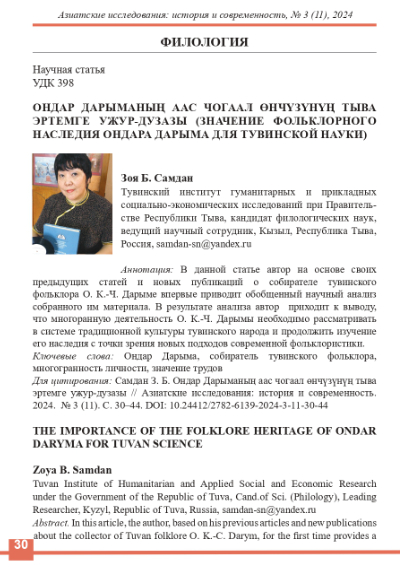
THE IMPORTANCE OF THE FOLKLORE HERITAGE OF ONDAR DARYMA FOR TUVAN SCIENCE
In this article, the author, based on his previous articles and new publications about the collector of Tuvan folklore O. K.-C. Darym, for the first time provides a generalized scientific analysis of the material he collected. As a result of the analysis, the author comes to the conclusion that the multifaceted activities of O.K.-C. Daryma should be considered in the system of traditional culture of the Tuvan people and continue to study their heritage from the point of view of new approaches of modern folklore.

SYNCRETIC TYPE OF PERFORMING TRADITION IN THE NARRATIVE FOLKLORE OF TUVANS
The author explores the evolution of the syncretic type of performers relying on field data, archival and published materials related to the Tuvan performing tradition. Storytelling, shamanism and myth performance are considered on the example of biographies and repertoires of representatives of three generations of performers from the Sut-Hol Kozhuun. There is a relevance of the problem under consideration in the fact that the analyzed material confirms the relatively stable living existence of the ancient syncretic type of the Tuvan performing tradition, which gradually differentiated and effected on the development of modern performance features. The author has found that the performing tradition of the Tuvans, based on their religious and mythological views, had been maintaining its continuity and stability for a long time, but only recently faced with a gradual transformation. The flourishing of the performing tradition of throat singing, which has a single ideological basis with storytelling, can influence the revival of storytelling art in modern Tuva.
-2022--70-80_rW0ER.jpg)
INDIAN STORIES IN THE EPIC AND FABULOUS MYTHOLOGICAL TRADITION OF THE TUVINIANS
The article examines the forms of borrowings and the peculiarities of the existence of book monuments of the East in the epic and fairy-tale-mythological tradition of the Tuvinians. In Tuva, the original versions of the "Gesariad", "The Tale of Khan-Harangue", "Jangar" and the versions of tales and fairy tales "Panchatantra", "Bigarmizhid Khan", "Arj-Borj Khan", "The Magical Dead", translated mainly from Tibetan, Sanskrit languages, existed orally". The author draws attention to the plots from the famous cycle of Indian stories "Birbaliana", which found echoes in Tuva in the form of intricate extensive fairy–tale plots - "The Wise Girl", "The Khan who was overcome by the truth", etc. The author also emphasizes the great role of storytellers and lamas who knew old Mongolian and Tibetan, thanks to whom the borrowed plots of book monuments of the East spread orally in Tuva. The article substantiates the idea of the existence of borrowed plots in Tuva, which indicate the involvement of the ancestors of Tuvans in the formation of common centers of writing and epic poetry - to the Sayano-Altai and Central Asian zonal epic community. These borrowed plots confirm the opinion about the living process of interaction and mutual enrichment of the cultures of the peoples of Central Asia, including Tuvinians.