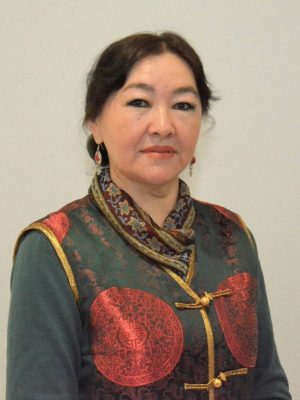
Lyudmila S. Mizhit
Publications by the Author
3 publications
VICTOR KOK-OOL’S HISTORICAL AND HEROIC DRAMA “SAMBAZHYK”: THE EXPERIENCE OF INTERPRETING THE IMAGE OF THE PROTAGONIST OF THE DRAMA AND THE MOTIVE OF THE UPRISING
The article examines scientific research on the national liberation movement of Tuvan Arats “Aldan-maadyr” (“Sixty Heroes”) in the 19th century, which preceded the writing of the play “Sambazhyk” by V. Kok-ool. The author attempts to interpret the image of the main character and the motive of the spontaneous uprising reflected in the historical and heroic drama “Sambazhyk”. The thirst for retribution is the leitmotif of the drama, which is repeatedly emphasized by the protagonist and other actors, becoming an impulse for the development of the plot. Rebel songs artfully selected by the playwright and samples of folk speech in the characters’ lines are given. The study of this play demonstrates the presence of the following artistic dominants: a tragic narrative, a clearly formulated motive of rebellion, romantic shades in the image of the protagonist, a pronounced antagonistic confrontation and the introduction of folklore speech into dialogical structures. However, in our opinion, the artistic representation of the main character in this drama does not have sufficient depth to fully reflect the heroic essence of the leader of the uprising.

THE MODERN TUVAN LITERATURE
This review article examines the main works of Tuvan literature of the post-Soviet period, which play an important role in enriching the spiritual culture of Tuvans. Modern Tuvan literature (lyrics, prose, drama) highlights various problems of historical and modern social life of Tuvan society. Poets began to think not in a narrow framework, but in a larger scale, embodying in literary creativity reflections at the junction of world literature, philosophy and religion. The results of the research could be used in basic courses on literary criticism and the history of Tuvan literature of the modern period.

ACHIEVEMENTS OF TUVAN LITERATURE IN THE SOVIET PERIOD
The article examines the most productive and eventful period of Tuvan fiction (the 1960s - the beginning of the 1990s) not only in terms of enriching the genre system, but also in terms of creating large, landmark works of national literature: novels, plays and poetry of the founders of Tuvan literature - Salchak Toka, Stepan Saryg-ool, Sergei Purbu, Viktor Kok-ool, as well as writers of the next generation - Kyzyl-Enik Kudazhy, Mongush Kenin-Lopsan, Salim Syuryun-ool, Vasily Mongush, Yuri Kyunzegesh, and others. At the end of that period, despite literary creativity under the influence of communist ideology subordinated to the principles of socialist realism, some Tuvan poets (Mongush Dorzhu, Alexander Darzhai, Igor Irgit, Anton Uerzhaa, Nikolay Kuular) were able to abandon the socially politicized view of reality and then get out of the stereotype.