Issue №1(5), 2023
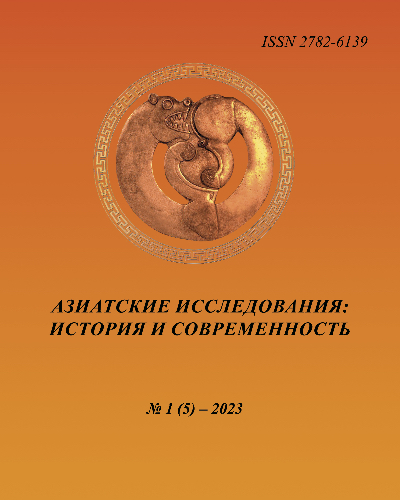
Issue №1(5)
- Year 2023
- Pages 159
- Published 27 Mar. 2023
- Views 415
- PDF downloads 0
- Permanent link to the issue https://asvestnik.ru/en/issue/1-5-2023
Articles in This Issue
11 itemsHistory

V. D. MART- OOL: HIS SCIENTIFIC, ORGANIZATIONAL AND RESEARCH ACTIVITIES (TO THE 65TH ANNIVERSARY OF HIS BIRTH)
The article has been written to continue the tradition laid down by Tuvan scientists of the first generation - to keep a collective chronicle of the main scientific activities of the institute, its leaders and Tuvan scientists. It has been prepared on the eve of the 65th anniversary of the organizer of science and scientist V. D. Mart-ool and presents a brief historical and biographical sketch of his life and work, including a brief overview of the largest and most significant scientific works of the researcher.

ARCHAEOLOGICAL RESEARCH OF TNIIYALI IN THE 70S OF THE XX CENTURY
The article is devoted to the archaeological research of the Tuvan Research Institute of Language and Literature (TRILLH) in the 70s of the XX century. As we can judge in accordance with the publication and archival materials, as well as scientific reports, this decade was extremely rich in the history of the Institute for research and discovery. As a result of Ulug-Khorum, Senek, Balgazyn and Yenisei archaeological expeditions of the Institute, hundreds of monuments of a funeral and memorial nature, as well as monuments of rock art and monumental art, were investigated. The source base of the article includes publications and archival materials, reports from the funds of the scientific archive of the TRILLH.

HISTORICAL TIES OF TUVA AND RUSSIA IN THE XVII - BEGINNING OF THE XX CENTURIES
The article considers the initial stage of the rapprochement of Tuva and Russia, highlights the main fateful dates of this period: 1604, 1728, 1897 and 1914. The author has revealed outlines (coverage) and character at different stages of the historical process of Tuva-Russian rapprochement. It has been noted that the data of the earliest stage (from the beginning of the XVII to the beginning of the second quarter of the XVIII century) were almost not involved in scientific circulation by researchers.

THE LIFE AND ACITIVITIES OF BAIR ALEXEY SHIRINMEEVICH (1904 - 1985)
The author of the article examines the biography of one of statesmen and politicians of the Tuvan People's Republic (hereinafter -TPR) Alexey Shirinmeevich Bair (1904-1985), who made a significant contribution to the development of the republic. The article has been based on archival documents. Alexey Shirinmeevich Bair did not belong to the category of forgotten statesmen, but nevertheless there is a gap in his biography, political and public activities. The author has made an attempt to fill in the gaps in his biography using his personal fund (f. 542), which is kept in the National Archive of the Republic of Tuva, and the documents he personally deposited in the archive of the TNIIYALI (now TIGPI).

SHAGDYR-SYURYUN OYUN (1904-1936) AS A STATESMAN AND A PARTY LEADER OF THE TUVAN PEOPLE'S REPUBLIC
The article is devoted to o Shagdyr-Syuryun Oyun Sanaa who was one of the state, party and trade union acitivists of the period of the Tuvan People's Republic. The author has revealed some previously unknown evidences related to his professional and personal life. There is a conclusion that Shagdyr-Syuryun Oyun played a significant role in the history of Tuva, and was one of the representatives of the TPR intelligentsia. And if not for his sudden death, he could have brought even more benefits for the Tuvan People`s Republic.
Philology

NAMES OF DOMESTIC ANIMALS’ DESEASES IN THE LANGUAGE OF TSENGEL TUVINIANS IN COMPARISON WITH THE TUVAN LANGUAGE
The Tsengel dialect is one of the foreign dialects of the Tuvan language. It is spoken by the Tuvans of Northwestern Mongolia, who live in the Tsengel sumon of the Bayan-Ulegei aimag. To some extent, we use the concept of “Tsengel dialect” conditionally, because at present the functional status of the Tuvan speech of the indigenous inhabitants of the Tsengel sumon of the Bayan-Ulegei aimag of Mongolia has not yet been established, as a result, the combination “language of the Tsengel Tuvans” sometimes appears in the work, where the term “ language" is not opposed to the term "speech", they are used by us as synonyms. The article provides a comparative analysis of the names of diseases of domestic animals in the speech of the Tsengel Tuvans with the literary Tuvan language, as well as with dialects, in some cases in neighboring Turkic and Mongolian languages.

THE MODERN TUVAN LITERATURE
This review article examines the main works of Tuvan literature of the post-Soviet period, which play an important role in enriching the spiritual culture of Tuvans. Modern Tuvan literature (lyrics, prose, drama) highlights various problems of historical and modern social life of Tuvan society. Poets began to think not in a narrow framework, but in a larger scale, embodying in literary creativity reflections at the junction of world literature, philosophy and religion. The results of the research could be used in basic courses on literary criticism and the history of Tuvan literature of the modern period.

SYNCRETIC TYPE OF PERFORMING TRADITION IN THE NARRATIVE FOLKLORE OF TUVANS
The author explores the evolution of the syncretic type of performers relying on field data, archival and published materials related to the Tuvan performing tradition. Storytelling, shamanism and myth performance are considered on the example of biographies and repertoires of representatives of three generations of performers from the Sut-Hol Kozhuun. There is a relevance of the problem under consideration in the fact that the analyzed material confirms the relatively stable living existence of the ancient syncretic type of the Tuvan performing tradition, which gradually differentiated and effected on the development of modern performance features. The author has found that the performing tradition of the Tuvans, based on their religious and mythological views, had been maintaining its continuity and stability for a long time, but only recently faced with a gradual transformation. The flourishing of the performing tradition of throat singing, which has a single ideological basis with storytelling, can influence the revival of storytelling art in modern Tuva.
Ethnography

SOME SEMANTIC ASPECTS OF NUMBER NINE IN HOUSEHOLD PRACTICE OF TUVANS
The article is devoted to some semantic aspects of the number nine among Tuvans. The sacredness of the number nine, like other numbers, has been formed over several centuries, during the different historical periods, under the influence of certain ideological and religious views, and has become an essential part of the tuvan spiritual culture.

KOIGUN-HAM: THE IMAGE OF A HARE IN THE SHAMANIC REPRESENTATIONS OF TUVANS
The article considers the image of a hare in connection with the shamanic beliefs of the Tuvans. Many representatives of the animal world in shamanism act as assistants (messengers) of shamans (tuv. ederinci, shapkynchy). Shamans during a special ceremony addresses some of them with a chant (tuv. algysh) to receive their help in completing tasks. The hare appears in different guises in the spiritual culture of the Tuvans. He is one of the main shamanic animals. Special algysh is also dedicated to the hare. In shamanism, in addition to faith in a shaman himself and his spiritual assistants, there is a faith in the magical power of fetishized attributes (tuv. eeren).
Socio-economic research

INSTITUTIONS OF INTERTERRITORIAL INTERACTION: PROSPECTS FOR TUVA?
Inter-territorial economic cooperation is a special phenomenon, the study of which economists, jurists and historians have started relatively recently. Meanwhile, the system of institutions regulating relations either competition or cooperation between regions or between municipal formations took shape in Russia during the decades of the implementation of modern economic reform. The article reveals the features of the formation of regulatory bases of interterritorial interaction in the context of both hierarchical and heterachical institutions. Particular attention is paid to such an informal institution as trust in interregional and intermunicipal relations. Hopefully the experience of interterritorial cooperation may be in demand in the Republic of Tyva.