Issue №1(1), 2022

Issue №1(1)
- Year 2022
- Pages 154
- Published 28 Mar. 2022
- Views 309
- PDF downloads 0
- Permanent link to the issue https://asvestnik.ru/en/issue/1-1-2022
Articles in This Issue
13 itemsHistory
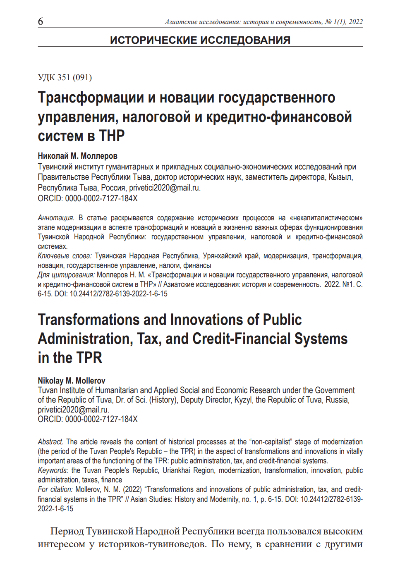
TRANSFORMATIONS AND INNOVATIONS OF PUBLIC ADMINISTRATION, TAX, AND CREDIT-FINANCIAL SYSTEMS IN THE TPR
The article reveals the content of historical processes at the “non-capitalist” stage of modernization (the period of the Tuvan People's Republic - the TPR) in the aspect of transformations and innovations in vitally important areas of the functioning of the TPR: public administration, tax, and credit-financial systems.

N. F. KATANOV’S SCIENTIFIC JOURNEY: KHAKASSIA - TUVA - XINJIANG (ON THE OCCASION OF THE 160TH ANNIVERSARY OF HIS BIRTH)
Ramil M. Valeev , Roza Z. Valeeva , Valentina N. Tuguzhekova
Professor N. F. Katanov (1862-1922) is one of the outstanding national scientists, representatives of Russian science, education and culture of the 19th-20th centuries. His life path and legacy reflected important events and trends in Oriental studies both in Russia and around the world, as well as Turkology. The stages of his biography and his vast creative legacy are interesting and extraordinary, instructive and tragic at the same time. He became the personification of two worlds in Russia - European and Asian. The biography and legacy of N. F. Katanov are of academic and especially scientific, educational, and humanistic interest. His life and works should not be perceived only within the history of Russian and European Oriental studies. It is necessary to take into account the broad socio-political and socio-cultural context of the development of Oriental studies, including Turkology, as well as Russian society and the state in the second half of the 19th - first quarter of the 20th century.

PARTICIPATION OF THE IRKUTSK GOVERNOR-GENERAL IN THE SOLUTION OF THE “URIANKHAI QUESTION” (THE SECOND HALF OF THE 19TH - EARLY 20TH CENTURIES)
This year marks the 200th anniversary of the establishment of the General Government of Eastern Siberia. In Imperial Russia, the power of governors-general was developed mainly in the outskirts, as well as in the areas governed by a special position. These territories include the Usinsk border district, and since 1914, the Tannu-Uriankhai region. This article analyzes the policy pursued by the Irkutsk Governor-General from the second half of the 19th century to 1914 - the time of the solution of the “Uriankhai question” before the establishment of the Russian protectorate.

FROM THE HISTORY OF THE FORMATION OF THE KHAKAS PEOPLE'S NATIONAL STATEHOOD (TO THE 30TH ANNIVERSARY OF THE REPUBLIC OF KHAKASSIA)
Elena P. Mamysheva , Elena V. Tyshta
This article examines the main stages of the formation of the Khakas people's statehood in the Soviet and post-Soviet times. It was emphasized that since 1917 self-determination of the ethnic group began. Khakassia has passed the way from the county - through the okrug - through the autonomous oblast - to the republic. The authors note that the proclamation of the Soviet statehood of the Khakas people in the form of an autonomous oblast was made possible thanks to the will of people and the participation of state and party bodies of the RSFSR in that process. The next significant stage in the formation of statehood in Khakassia was the formation of the Republic of Khakassia as a subject of the Russian Federation. The event led to the formation of new public authorities, which had a significant degree of political and economic independence.
Archaeology

CENTRAL TUVA (TYVA) IN THE STUDIES OF URAL FEDERAL UNIVERSITY
The paper offers a survey of the studies results of archaeological sites in Central Tuva (Tyva). The students from the Ural State University, Sverdlovsk (Ural Federal University, Yekaterinburg) joined Sayan-Tuva archaeological expedition and participated in the archaeological excavations under the guidance of the author of the current paper from 1972 to 1982. For ten years a group of experts and students from the Ural State University performed excavations in Ulug-Khem district in Aimyrlyg, Aimyrlyg 2 and Dag-Arazy (Aimyrlyg 3) burial fields as well as in the area of the fortified construction, known as the “road of Genghis Khan”.
Literary studies

ACHIEVEMENTS OF TUVAN LITERATURE IN THE SOVIET PERIOD
The article examines the most productive and eventful period of Tuvan fiction (the 1960s - the beginning of the 1990s) not only in terms of enriching the genre system, but also in terms of creating large, landmark works of national literature: novels, plays and poetry of the founders of Tuvan literature - Salchak Toka, Stepan Saryg-ool, Sergei Purbu, Viktor Kok-ool, as well as writers of the next generation - Kyzyl-Enik Kudazhy, Mongush Kenin-Lopsan, Salim Syuryun-ool, Vasily Mongush, Yuri Kyunzegesh, and others. At the end of that period, despite literary creativity under the influence of communist ideology subordinated to the principles of socialist realism, some Tuvan poets (Mongush Dorzhu, Alexander Darzhai, Igor Irgit, Anton Uerzhaa, Nikolay Kuular) were able to abandon the socially politicized view of reality and then get out of the stereotype.

THE ORIGIN OF TUVAN PROSE FOR CHILDREN
The paper describes the role of the first periodicals, school textbooks and translations of Russian classical children's literature in the formation of Tuvan prose for children. The periodicals in Mongolian and Tuvan languages widely covered the topics of modern times of the Tuvan People's Republic, which were of great educational importance and contributed to expanding mental outlook of children. Translation of the works of classical authors of Russian children's literature was a great school of skills for starting Tuvan writers.
Cultural studies

NEW STUDIES OF THE OLD BELIEVERS OF THE YENISEI REGION
The article summarizes some of the results of field and archival research by scientists - historians, ethnographers, art historians, folklorists of the Old Believers of the chapel concord inhabiting the vast region of the Yenisei basin. Expeditionary and cameral study was carried out during 2016 - 2020 and gave tangible results in the form of monographs that have already been published, individual issues of journals devoted to that topic, and several dozen articles that reveal the unique degree of preservation of traditions and the active development of innovations in the material and spiritual culture of the Old Believers' phenomenon.
Ethnography

ABOUT THE TERM “URAANGKHAI” IN YAKUT FOLKLORE
This article examines the existence and meaning of the term “Uraankhgai” in the Yakut folklore. The word “Uraankhgai” is an old self-name of the Sakha people. The ancient legends tell about the ancestral home of the Sakha people - Uraangkhai. The article deals with the historiography of the seeking for this ancestral home of the Sakha. The term “Uraankhgai” in the historical memory of the Sakha is associated with the Turkic-Mongolian area. At the same time, there were seekings for the roots of the ethnonym “Uraangkhai” in the Samoyed and Tungus-Manchu ethnic environment. Separately, the Sakha legends about the arrival of the Uraangkhai tribe from the south are analyzed.

ETHNIC GROUPS OF THE KHOVD TUVANS OF MONGOLIA
The article describes the composition of Tuvan ethnic groups from the Buyant somon of the Khovd aimag in Mongolia, who moved to that area in 1930-1940 from the territory of the Xinjiang Uygur Autonomous Region of the People's Republic of China. Data about the number of representatives of various clans at the present time, the territory of their settlement, historical information about the inclusion of the considered ethnic groups into one of three Tuvan khoshuns of the Altai Uriankhians are given; field materials containing information on the origin of irgit, khaa-dargan, khöyuk, chag-tyva clans are presented. It is shown that the main difference between ethnic groups is the predominant type of their economic activity: chag-tyva (hunting), irgit (cattle breeding), dongak (blacksmithing).
Socio-economic research

PROSPECTS OF PARTICIPATION OF THE REPUBLIC OF TUVA IN THE FERROUS METALLURGY DEVELOPMENT OF ASIAN RUSSIA
The growing attention of the state to Siberia and Russian Far East makes determines the need to work out directions for the development of the ferrous metallurgy of Asian Russia. Since the Republic of Tuva has significant reserves of “W” and “GJ” rare grades coking coals, it is necessary to study the possibility of the republic's participation in such development. The purpose of the research is to identify prospective directions for coking coal mining in the Republic of Tuva in relation to possible directions for the ferrous metallurgy development in Asian Russia.

URBANIZATION OF TUVA IN THE SOVIET AND MODERN PERIODS
The paper considers the urbanization of Tuva as one of the most important aspects of modernization. The author covers in detail the dynamics of the main quantitative and qualitative indicators of the urbanization of the region. It is emphasized that the urban settlements of Tuva developed extensively due to the accelerated pace of urbanization, the formation of the urban population primarily because of the countrymen, as well as the priority of the city's economy over its socio-cultural development. The analysis of the transformation of the structure of the urban population of the region in the context of its social, national and educational composition is carried out. Special attention is paid to the results of the urbanization of Tuva, and the study of its impact on the transformation of all spheres of public life. The study is based on the analysis of official statistics and data from a sociological survey conducted in Tuva in 2019. In general, urbanization here, in addition to catching up characteristic, has a number of specific features primarily concerned with the peculiarities of the geographical location of the republic, its historical development and national status. However, in general, the vector of urban development of Tuva is identical to the direction of development of the Russian Federation and it is determined by the level of development of the economic sphere of society.
Sociology

POLITICAL VALUES AS A MEANS OF FORMING THE CIVIC POSITION OF RUSSIAN YOUTH (BASED ON MATERIALS OF REGIONAL STUDIES)
The paper pays attention to the issue of value preferences of Russian youth as in the case of one of the regions of the Russian Federation - the Kemerovo region - Kuzbass. The problem of the political values of young people is considered through the prism of the socialization system of young people within the framework of the youth policy implemented by the state, which has a direct impact on the political beliefs, values and moods of young people. It is shown the inconsistency of the value beliefs of modern youth, which is due to the Russian model of democratic development.