Issue №4(16), 2025
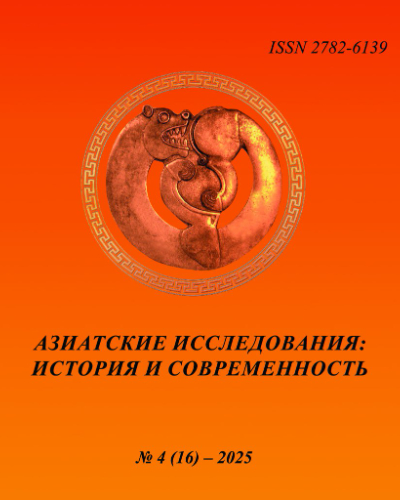
Issue №4(16)
- Year 2025
- Pages 121
- Published 20 May. 2025
- Views 178
- PDF downloads 112
- Permanent link to the issue https://asvestnik.ru/en/issue/4-16-2025
Articles in This Issue
9 itemsHistory
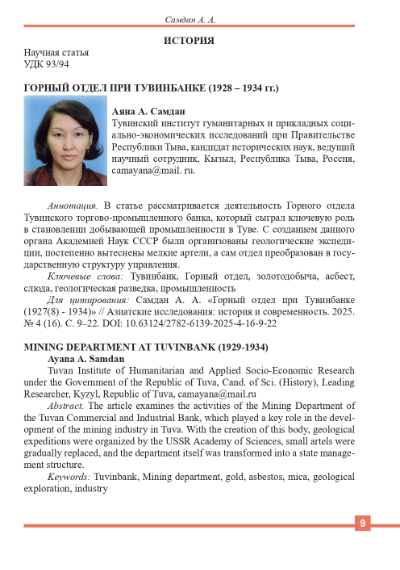
MINING DEPARTMENT AT TUVINBANK (1929-1934)
The article examines the activities of the Mining Department of the Tuvan Commercial and Industrial Bank, which played a key role in the development of the mining industry in Tuva. With the creation of this body, geological expeditions were organized by the USSR Academy of Sciences, small artels were gradually replaced, and the department itself was transformed into a state management structure.
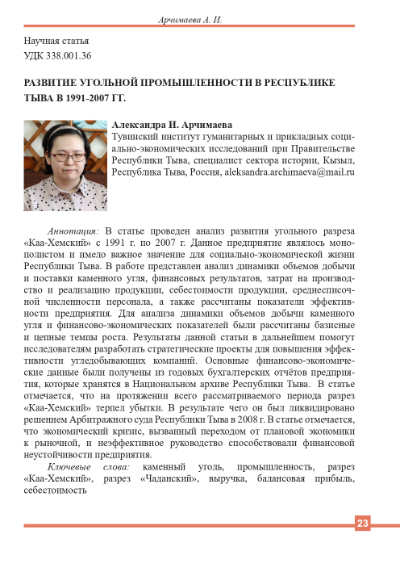
THE DEVELOPMENT OF THE COAL INDUSTRY IN THE REPUBLIC OF TUVA IN 1991-2007
The article conducted an analysis of the development of the Kaa-Khamsky coal section from 1991 to 2007. This enterprise was a monopolist and was important for the socio-economic life of the Republic of Tuva. The work presents an analysis of the dynamics of the volume of production and supply of stone coal, financial results, costs of production and sale of products, the cost of products, the average personnel, as well as the performance indicators of the enterprise. To analyze the dynamics of the volume of coal production and financial and economic indicators, the basic and chain growth rates were calculated. The results of this article will further help researchers to develop strategic projects to increase the efficiency of coaling companies. The main financial and economic data were obtained from the annual accounting reports of the enterprise, which are stored in the National Archive of the Republic of Tuva. The article notes that throughout the entire period under consideration, the «Kaa-Khem» section suffered losses. As a result, it was liquidated by the decision of the Arbitration Court of the Republic of Tuva in 2008. The article notes that the economic crisis caused by the transition from a planned economy to a market, and ineffective leadership contributed to the financial instability of the enterprise.
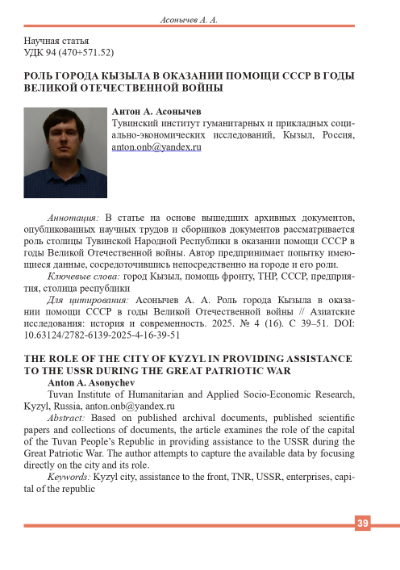
THE ROLE OF THE CITY OF KYZYL IN PROVIDING ASSISTANCE TO THE USSR DURING THE GREAT PATRIOTIC WAR
Based on published archival documents, published scientific papers and collections of documents, the article examines the role of the capital of the Tuvan People’s Republic in providing assistance to the USSR during the Great Patriotic War. The author attempts to capture the available data by focusing directly on the city and its role.
Folklore research
MELODIOUSLY PERFORMED TUVAN HEROIC TALES AND FOLK TALE IN ARCHIVAL RECORDS OF TIGPI IN 1959-1979: ISSUES OF SYSTEMATIZATION AND CATALOGIZATION
Ayasmaa D-B. Baranmaa (publ. also as Mongush)
The scientific archive of TIGPI has preserved unique recordings of heroic tales and fairy tales performed in melodic recitative, recorded by scientists and researchers of TNIIYALI (TIGI). Currently, 68 samples of such records have been identified, dating back to 1959-1979. The article is devoted to the history of recordings of heroic tales and fairy tales, the identification of storytelling schools of melodic performance, individual storytellers, and the issues of systematization of existing recordings. The work briefly describes the degree of study and fixation of epic melodies. For modern Tuvan ethnomusicology, the further study of tales and fairy tales performed in melodic recitative is one of the most pressing tasks, given the decline of the storyteller tradition. The first step in this process is to identify the number of recordings available in the archive. As a result of this research, a list of tales and fairy tales has been compiled based on a chronological order, indicating the completeness and quality of the recordings. Additionally, efforts have been made to clarify the data and sequence of the recorded samples, allowing for a comprehensive understanding of the history of recordings of melodically performed tales and fairy tales during the relevant period and for drawing preliminary conclusions.
COMIC ELEMENTS IN THE TUVAN HEROIC EPIC “BOKTU-KIRISH, BORA-SHEELEI”
Shenne Y. Khomushku (publ. also as Kuzhuget)
The article is devoted to the analysis of comic elements in the Tuvan heroic epic “Boktu-Kirish, Bora-Sheelei”, which centers on the unique image of a maiden-warrior and her heroic deeds — a figure unparalleled within the Tuvan epic tradition. The relevance of the study lies in the fact that the category of the comic has so far remained on the periphery of scholarly attention in Tuvan epic studies, while traditional research has focused primarily on the poetics of the heroic epic. The aim of this work is to reveal the specific manifestations of comic elements in the poetics of the Tuvan heroic epic “Boktu-Kirish, Bora-Sheelei” through an analysis of the image of the maiden-warrior and her heroic actions. The scientific novelty of the study consists in the fact that, for the first time, an attempt has been made to examine comic elements manifested in the plotline involving the disguise and impersonation of the heroine Boktu-Kirish and her participation in male contests, interpreted within the framework of folk conceptions of gender roles. The methodological basis of the research combines descriptive and structural approaches, integrating methods of semantic analysis of the epic text, grounded in the conceptual frameworks of V. Ya. Propp, Yu. B. Borev, and other theorists of the comic. The analysis reveals that comic elements in the Tuvan heroic epic “Boktu-Kirish, Bora-Sheelei” are manifested through techniques such as the hyperbolization of the heroine’s appearance with grotesque-comic features, mockery of enemies, tricking secondary characters, and leaving them in a ridiculous position. These identified features open new perspectives for the study of laughter culture in the folklore heritage of the Tuvan people.
Ethnography
TRADITIONAL ORIENTATION SYSTEM IN THE MOUNTAINOUS TAIGA REGION AMONG THE KHAKASS PEOPLE
This article examines traditional Khakass methods of orientation in the mountain taiga. The orientation system was primarily developed from an early age, beginning at the age of 7-8, first near their home, farmstead, or village, and then in the distant taiga. This formed a map of the area in the taiga dweller’s mind. The main elements of orientation were natural features: mountains, rivers, ravines, cliffs, and crags. Khakass taiga dwellers navigated by celestial bodies – the sun, moon, and the North Star. Words played an important role in orientation during economic activities in the taiga: the names of mountains, terrain, rivers, ledges, ravines, passes, and river fords were used to create a virtual map in the mind. Special signs, such as notches on a trivet, were used to indicate the direction, route, and number of hunters. The direction of the route and the number of taiga dwellers were also indicated by small stones laid out near the campfire. To mark their route, they used “oyyg” notches on trees. Our research is based primarily on the author’s ethnographic fieldwork.
FUNCTIONAL FEATURES OF OVAA AMONG THE TUVINIANS
The article discusses religious structures called ovaa, which were widespread in Tuva. There were two types of ovaa: stone mounds built on mountain passes and tent-shaped structures erected on mountains, foothills, or plains. The main purpose of these structures was to worship local natural objects, such as mountains and water sources, which the Tuvan people believed had invisible masters. These masters needed to be appeased through the use of ovaa. However, their functional value went beyond religious structures. They also served as landmarks in the space where the nomads moved. Over time, the meaning of the ovaa, primarily in the form of a tent, expanded to become a marker of ancestral lands. The most radical changes were related to Buddhist ideas about local “masters” and Buddhist deities, so the local customs began to change. In a visible way, the new knowledge affected the interior design of the ovaa. Now, people began to place precious items and images of Buddhist deities on a small table in the center of the tent. Along with the spiritual changes, both types of ovaa were also affected by historical developments in Tuvan society. They were used as border markers along the southern and northern borders of Tuva during the 1930s and 1940s.
Sociocultural studies
PUBLISHING ACTIVITIES OF THE CULTURAL STUDIES SECTOR OF THE TUVAN INSTITUTE OF HUMANITARIAN AND APPLIED SOCIO-ECONOMIC RESEARCH
The article examines a brief history of the search in various archives of Russia and the preparation for publication of manuscripts by scientists of the late XIX – early XX centuries about Tuva. Information is also provided on the content of books published by the TIHASER Cultural Studies sector based on their materials related to the history of Tuvan culture, as well as about the authors themselves and their travels.
Economics
FORMATION OF DIVERSIFIED (MULTIPLE) SPECIALIZATION OF THE ECONOMY OF THE REPUBLIC OF THE TUVA
Aliya D. Bikmaeva (publ. also as Rakhmatullina)
The article analyzes the existing specialization sectors of the economy of the Republic of Tyva, which are determined using the Hoover-Ballas coefficient. Today, the specialization sectors of the republic are mining and agriculture. Based on the analysis, we recommend increasing the number of specialization sectors in order to diversify the economy within the framework of multiple specialization and the concept of “smart specialization” and propose the development of promising activities for the region: food industry, antler reindeer herding, deepening the processing of raw materials of the mining industry, tourism.