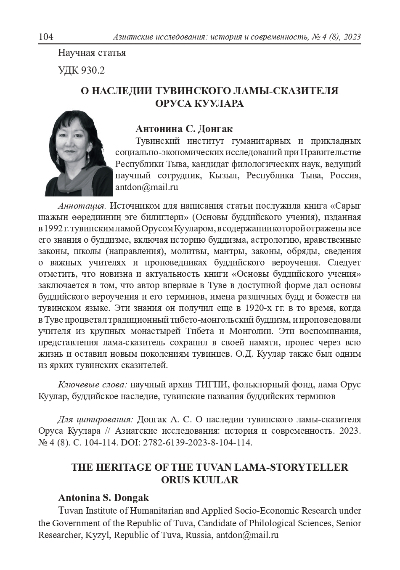
Antonina S-O. Dongak

Publications by the Author
3 publications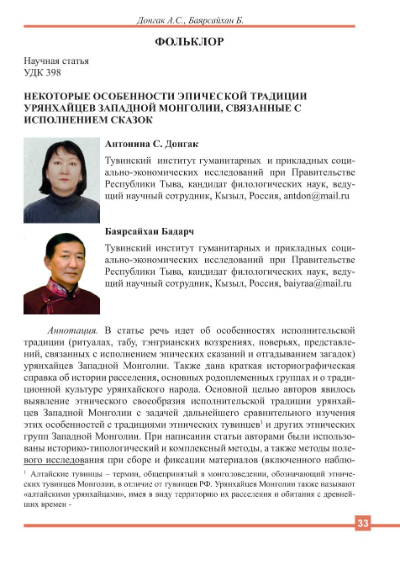
SOME FEATURES OF THE EPIC TRADITION OF THE URIANKHAI PEOPLE OF WESTERN MONGOLIA RELATED TO THE PERFORMANCE OF FAIRY TALES
The article deals with the features of the epic tradition (rituals, taboos, Tengrian views, beliefs, ideas related to the performance of epic tales and riddles) of the Uryankhai people of Western Mongolia. It also provides a brief historiographical background on the history of settlement, the main tribal groups and the traditional culture of the Uryankhai people. The main goal of the authors was to identify the ethnic uniqueness of the performing tradition of the Uryankhai people of Western Mongolia with the task of further comparative study of these features with the traditions of the Tuvans and other Mongolian-speaking peoples. When writing the article, the authors used historical-typological and complex methods, as well as field research methods when collecting and recording materials (involved observation, interviews, surveys), applied the review and generalization method. The novelty of the study is that for the first time in Tuvan folklore studies the authors paid attention to the epic traditions of foreign folklore with the task of further comparative study of two different epic traditions - the Tuvans and the Uriankhais. The material for the study was the field materials of the authors obtained during the implementation of the expeditionary project of the Russian Humanitarian Science Foundation-2015: 15-04-18003 e - “Small ethnic groups of Turkic origin (Khotons, Uriankhais of Mongolia and Tuvans of China): spiritual and material culture” (headed by A.S. Dongak); As a result, the authors came to the conclusion that the epic traditions of the Tuvans and the peoples of Western Mongolia have many common features associated with the performance of fairy tales (seasonal timing, musical accompaniment (although the Tuvans did not always practice accompaniment with instruments), a respectful attitude towards the spirits-masters of the fairy tale and nature, the custom of presenting a small gift to the storyteller, etc.).
COLLECTION OF ARCHIVAL DOCUMENTS ON THE HISTORY OF TUVA IN 4 VOLUMES: THE PROBLEM OF TRANSLATION INTO RUSSIAN AND PUBLICATION
“Collections of archival documents on the history of Tuva” in 4 volumes: (Volume I (1738-1911) - 498 pages; Volume II (1911-1921) - 468 pages; Volume III (1921-1944) - 418 pages; Volume IV (1944-1991) -166 pages; further – Collections), published in 2011-2014 in Ulaanbaatar, became the result of the joint work of Tuvan and Mongolian historians. The peculiarity of the publications is that for the first time the originals of archival documents in the Old Mongolian script were introduced into scientific circulation. At the same time, the difficulty lies in the fact that these archival documents in the Old Mongolian script as sources remain inaccessible to Tuvan researchers to this day, although 10 years have passed since the publication of the Collections. The reason is that the Sources have not been translated from the old Mongolian Language. Therefore, the team of scientists from Tuva and Mongolia sets the objectives to translate these documents into modern Cyrillic Mongolian and Russian, to make a source description of the sources. It is necessary a comprehensive description based on historical, cultural, historical, philological and source-based methods of studying written monuments, taking into account similar experiences in Soviet-Russian and world mongolistics. The publication of these documents in Russian will become additional sources when writing new works by Tuvinologists of different profiles.
THE HERITAGE OF THE TUVAN LAMA-STORYTELLER ORUS KUULAR
The source for writing the article was the book "Saryg shazhyn ooredinin ege biligleri" (Fundamentals of Buddhist teaching), published in 1992 by the Tuvan lama Orus Kuular, the content of which reflects all his knowledge about Buddhism, including the history of Buddhism, astrology, moral laws, schools (directions), prayers, mantras, laws, rituals, information about important teachers and preachers of the Buddhist faith. It should be noted that the novelty and relevance of the book "Fundamentals of Buddhist Teaching" lie in the fact that for the first time in Tuva, the author gave the basics of Buddhist doctrine and its terms, the names of various Buddhas and deities in the Tuvan language in an accessible form. He had received this knowledge in the 1920s when traditional Tibetan-Mongolian Buddhism flourished, and teachers from large monasteries in Tibet and Mongolia preached in Tuva. The lama-storyteller kept these memories and ideas in his memory, carried them through his whole life and left them to new generations of Tuvinians. Kuular was also one of the brightest Tuvan storytellers.