Issue №4(8), 2023

Issue №4(8)
- Year 2023
- Pages 121
- Published 24 Mar. 2023
- Views 570
- PDF downloads 186
- Permanent link to the issue https://asvestnik.ru/en/issue/4-8-2023
Articles in This Issue
8 itemsHistory
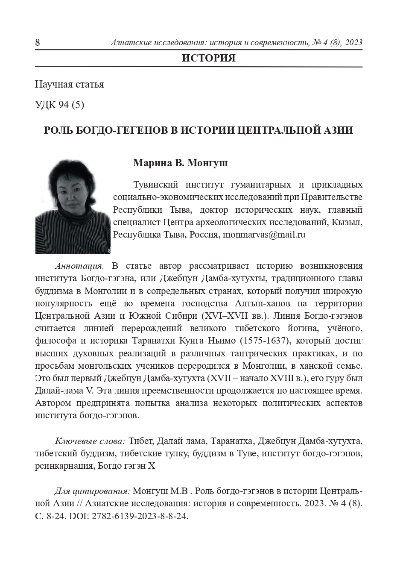
THE ROLE OF BOGDO-GEGENS IN THE HISTORY OF CENTRAL ASIA
In this article, the author examines the history of the emergence of the Bogdo-gegen institute, or Jebtsun Damba-Hutukhta, the traditional head of Buddhism in Mongolia and in neighboring countries, which gained wide popularity during the rule of the Altyn Khans in Central Asia and Southern Siberia (XVI-XVII centuries). The line of Bogdo-gegens is considered to be the line of rebirths of the great Tibetan yogi, scientist, philosopher and historian Taranatha Kung Nyimo (1575-1634), who achieved higher spiritual realizations in various tantric practices, and at the request of Mongolian disciples was reborn in Mongolia, in a khan family. This was the first Djebtsun Damba-hutukhta (XVII - early XVIII century), his guru was the Dalai Lama V. This line of succession continues to the present. The author tries to analyze some political aspects that are behind the institution of bogdo-gegans.
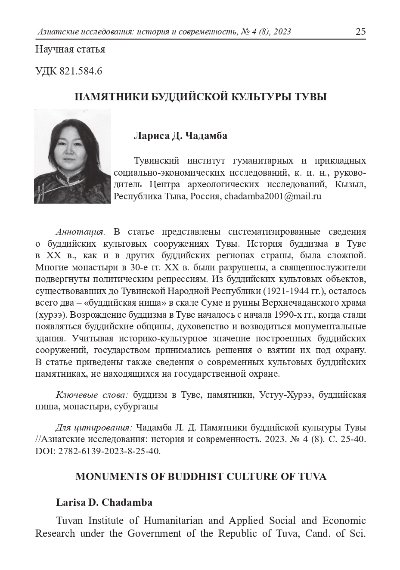
MONUMENTS OF BUDDHIS CULTURE OF TUVA
The article presents systematized information about Buddhist religious buildings in Tuva. The history of Buddhism in Tuva in the XX century was complicated as in other Buddhist regions of the country. Many monasteries were destroyed in the 30s of the XX century, and the clergy were subjected to political repression. Only two of the Buddhist relics existed before the Tuvan People's Republic (1921-1944) have ben remain - the "Buddhist niche" in the Sume rock and the ruins of the Verkhnechadan Temple (khure). The revival of Buddhism in Tuva began in the early 1990s, when Buddhist communities, clergy began to appear and monumental buildings were erected. Taking into account the historical and cultural significance of the Buddhist relics, the authorities decided to take them under protection. The article also provides information on the number of Buddhist religious monuments that are not under state protection.
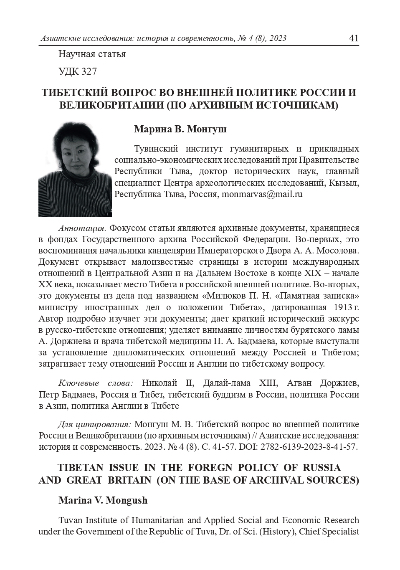
TIBETAN ISSUE IN THE FOREGN POLICY OF RUSSIA AND GREAT BRITAIN (ON THE BASE OF ARCHIVAL SOURCES)
The focus of the article is archival documents stored in the funds of the State Archive of the Russian Federation. Firstly, these are the memoirs of the head of the Chancellery of the Imperial Court, A.A. Mosolov. The document opens little-known pages in the history of international relations in Central Asia and the Far East in the late XIX - early XX century, shows the place of Tibet in Russian foreign policy. Secondly, these are documents from a case called “Milyukov P. N. ”Memo” to the Minister of Foreign Affairs on the State of Tibet”, dated 1913. The author studies these documents in detail; gives a brief historical digression into Russian-Tibetan relations; pays attention to the personalities of Buryat Lama A. Dorzhiev and Tibetan medicine doctor P.A. Badmaev, who advocated the establishment of diplomatic relations between Russia and Tibet; touches on the topic of relations between Russia and England on the Tibetan issue.
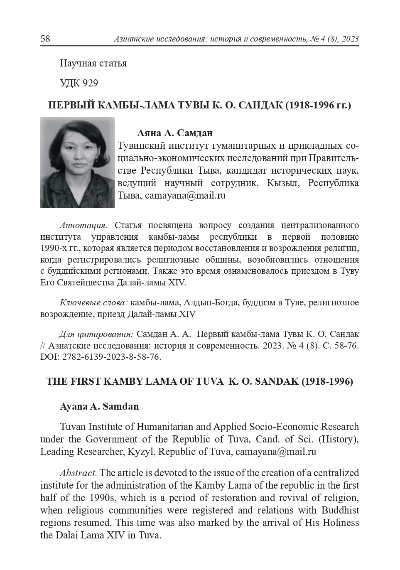
THE FIRST KAMBY LAMA OF TUVA K. O. SANDAK (1918-1996)
The article is devoted to the issue of the creation of a centralized institute for the administration of the Kamby Lama of the republic in the first half of the 1990s, which is a period of restoration and revival of religion, when religious communities were registered and relations with Buddhistm regions resumed. This time was also marked by the arrival of His Holiness the Dalai Lama XIV in Tuva.
Source studies
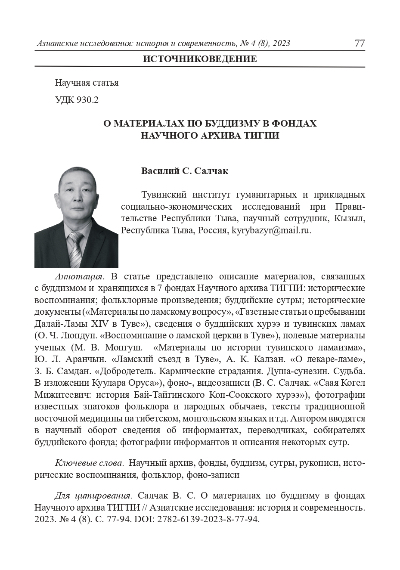
BUDDHIST MATERIALS IN THE FUNDS OF THE SCIENTIFIC ARCHIVE OF TUVAN INSTITUTE OF HUMANITARIAN AND APPLIED SOCIO-ECONIMIC RESEARCH UNDER THE GOVERNMENT OF THE REPUBLIC OF TUVA
The author describes materials related to Buddhism, and stored in 7 funds of the Scientific Archive of TIGASER: historical memories; different genres of folklore; Buddhist sutras; data on the history of Buddhism in Tuva (“Materials on the Lama's question”, “Newspaper articles about the arrivale of the 14th Dalai Lama in Tuva”), information about Buddhist khurees and Tuvan Lamas (“O. C. Lyundup. Memories of the Lama's churches in Tuva"), field materials of scientists (as "M. V. Mongush. Materials on the history of Tuvan Lamaism", Y. L. Aranchyn "Lama's Congress in Tuva", A. K. Kalzan "About Emchi-Lama", Z. B. Samdan “Virtue. Karmic suffering. The soul is a sunezin. Fate. told by Kuular Orus"), photographs of famous experts in folklore and folk customs, texts of traditional oriental medicine in Tibetan, Mongolian, etc. The author has introduces information about informants, translators, and collectors of the Buddhist fund; photographs of informants and copies of some sutras.
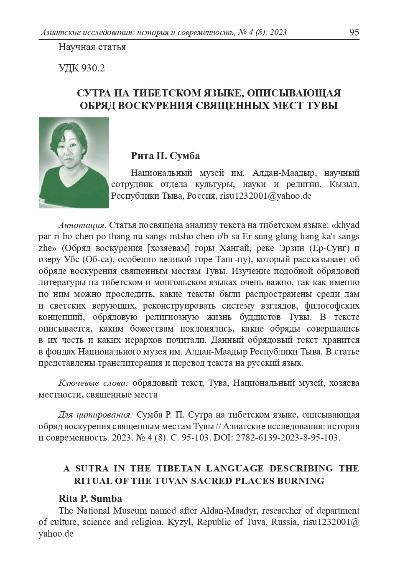
A SUTRA IN THE TIBETAN LANGUAGE DESCRIBING THE RITUAL OF THE TUVAN SACRED PLACES BURNING
The article focuses on the analysis of a Tibetan text describing the ritual of offering to sacred sites in Tuva. It is important to investigate such ritual literature in Tibetan and Mongolian is crucial, as it allows tracing the circulation of texts among lamas and lay believers, reconstructing the system of views, philosophical concepts, and ritual religious life of Tuva's Buddhists. The text describes the deities worshiped, the rituals performed in their honor, and the revered hierarchs. This ritual text is stored in the collections of the National Museum named after Aldan-Maadyr in the Republic of Tuva. The article includes the transliteration and translation of the text into the Russian language.
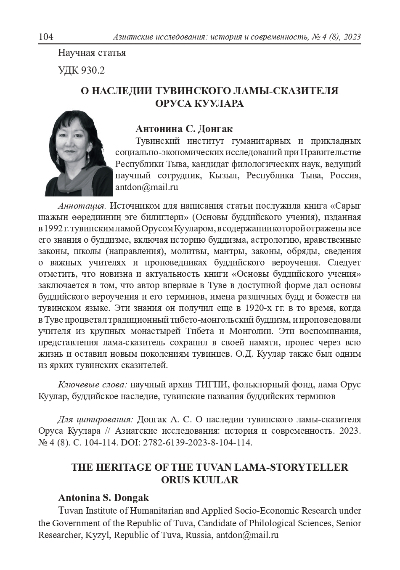
THE HERITAGE OF THE TUVAN LAMA-STORYTELLER ORUS KUULAR
The source for writing the article was the book "Saryg shazhyn ooredinin ege biligleri" (Fundamentals of Buddhist teaching), published in 1992 by the Tuvan lama Orus Kuular, the content of which reflects all his knowledge about Buddhism, including the history of Buddhism, astrology, moral laws, schools (directions), prayers, mantras, laws, rituals, information about important teachers and preachers of the Buddhist faith. It should be noted that the novelty and relevance of the book "Fundamentals of Buddhist Teaching" lie in the fact that for the first time in Tuva, the author gave the basics of Buddhist doctrine and its terms, the names of various Buddhas and deities in the Tuvan language in an accessible form. He had received this knowledge in the 1920s when traditional Tibetan-Mongolian Buddhism flourished, and teachers from large monasteries in Tibet and Mongolia preached in Tuva. The lama-storyteller kept these memories and ideas in his memory, carried them through his whole life and left them to new generations of Tuvinians. Kuular was also one of the brightest Tuvan storytellers.
Reviews
![Article cover REVIEW OF MONOGRAPHY BY NATSAK O. D. "NEPOLNYE SEM'I I MONORODITEL'SKIE PRAKTIKI ZHENSHHIN V SOVREMENNOM TUVINSKOM OBSHHESTVE (GENEZIS, SPECIFIKA, STRATEGII)" [SINGLE-PARENT FAMILIES AND SINGLE-PARENT PRACTICES OF WOMEN IN MODERN TUVAN SOCIETY (GENESIS, SPECIFICS, STRATEGIES)]. ABAKAN, KHAKASS BOOK PUBLISHING HOUSE, 2023. 240 P.](/files/journal/4-8-2023/115-120/cover-4-8-2023--115-120_NKEzU.jpg)
REVIEW OF MONOGRAPHY BY NATSAK O. D. "NEPOLNYE SEM'I I MONORODITEL'SKIE PRAKTIKI ZHENSHHIN V SOVREMENNOM TUVINSKOM OBSHHESTVE (GENEZIS, SPECIFIKA, STRATEGII)" [SINGLE-PARENT FAMILIES AND SINGLE-PARENT PRACTICES OF WOMEN IN MODERN TUVAN SOCIETY (GENESIS, SPECIFICS, STRATEGIES)]. ABAKAN, KHAKASS BOOK PUBLISHING HOUSE, 2023. 240 P.
-