Issue №2(14), 2025
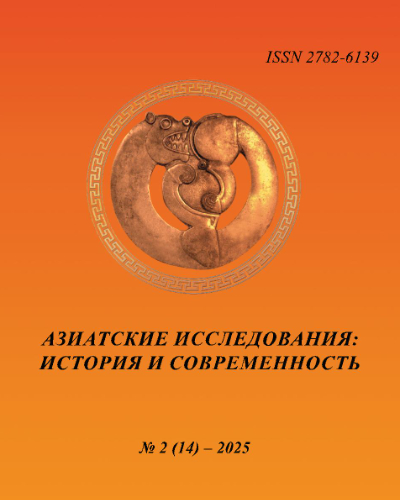
Issue №2(14)
- Year 2025
- Pages 173
- Published 10 Nov. 2025
- Views 209
- PDF downloads 109
- Permanent link to the issue https://asvestnik.ru/en/issue/2-14-2025
Articles in This Issue
8 itemsEthnography
MODERN SOCIAL PRACTICES AS A WAY OF REPRESENTING OF THE TRADITIONAL CULTURE OF TUVANS
The article is devoted to the study of social practices as one of the ways of representing the traditional culture of Tuvans in a changing socio-cultural reality. The work is based on materials collected by the author during the visits to public events in the republic on the day of their holding (Naadym, Shagaa, festivals and competitions), interviewing Tuvan craftsmen as subjects of ethnic entrepreneurship and active actors in ethnosocial processes to revive the Tuvan material culture, as well as studying Internet content as a platform for expressing ethnic identity of Tuvans, and analysis of scientific literature. The author comes to the conclusion that in the context of a changing socio-cultural paradigm, Tuvans, as carriers of ethnic culture, are mastering other ways of communicating, and broadcasting their identity and cultural heritage, which leads to changes in their ways of actualizing, transmitting, and storing information. Five blocks of public practices have been conditionally identified. These include national and folk holidays in a modern format, festivals and competitions as a way to revive and popularize traditional culture, educational activities with a regional and ethnic orientation of its content, ethnic entrepreneurship as a way to adapt tradition to market relations, the active development of the Tuvan digital world and the formation of the “Tuvan” cyberspace as a place of ethnic identity transmission. What they have in common is the activity of organizing events, activities, and other activities that represent elements, images, symbols, forms, and knowledge about Tuvan traditional culture. Their analysis shows that the values and forms of ethnocultural practices of the former tradition are being reconstructed and integrated into the information space of modern society acquiring the characteristics of modern social practices.
Folklore
SOME FEATURES OF THE EPIC TRADITION OF THE URIANKHAI PEOPLE OF WESTERN MONGOLIA RELATED TO THE PERFORMANCE OF FAIRY TALES
Antonina S-O. Dongak , Bayarsaykhan Badarch
The article deals with the features of the epic tradition (rituals, taboos, Tengrian views, beliefs, ideas related to the performance of epic tales and riddles) of the Uryankhai people of Western Mongolia. It also provides a brief historiographical background on the history of settlement, the main tribal groups and the traditional culture of the Uryankhai people. The main goal of the authors was to identify the ethnic uniqueness of the performing tradition of the Uryankhai people of Western Mongolia with the task of further comparative study of these features with the traditions of the Tuvans and other Mongolian-speaking peoples. When writing the article, the authors used historical-typological and complex methods, as well as field research methods when collecting and recording materials (involved observation, interviews, surveys), applied the review and generalization method. The novelty of the study is that for the first time in Tuvan folklore studies the authors paid attention to the epic traditions of foreign folklore with the task of further comparative study of two different epic traditions - the Tuvans and the Uriankhais. The material for the study was the field materials of the authors obtained during the implementation of the expeditionary project of the Russian Humanitarian Science Foundation-2015: 15-04-18003 e - “Small ethnic groups of Turkic origin (Khotons, Uriankhais of Mongolia and Tuvans of China): spiritual and material culture” (headed by A.S. Dongak); As a result, the authors came to the conclusion that the epic traditions of the Tuvans and the peoples of Western Mongolia have many common features associated with the performance of fairy tales (seasonal timing, musical accompaniment (although the Tuvans did not always practice accompaniment with instruments), a respectful attitude towards the spirits-masters of the fairy tale and nature, the custom of presenting a small gift to the storyteller, etc.).
ETHNIC MUSICAL DIALOGUE: FOLK SONGS OF THE TUVANS FROM TSENGEL AND THEIR BORROWINGS
The article analyzes the traditional songs of the Tuvans of the Tsengel sumon of the Bayan-Ulgii aimag of Western Mongolia, which represent an ancient cultural heritage reflecting the wisdom of the people with unique melodic turns and a variety of genres. The article examines the basic traditional songs of the Tsengel Tuvans of Mongolia, collected during an expedition in 2015, and also presents a comparative analysis of general and local characteristics with the materials of previous researchers E. Taube, G. Zolbayar and others, starting from 1966. The author concludes that since the end of the 1980s of the last century, the tours of the folklore and ethnographic ensemble “Tyva” have contributed to the cultivation of folk and original songs of the Tsengel Tuvans, which has become an important milestone in the history of the modern culture of Tuva. The motives of songs such as “Mazhalykta turgan chylgymnyng” (“My herd at the hill”) and “Kongurei”, performed by the Sengel vocal and instrumental group “Ak Bedik”, represent an interesting object for research in the context of cultural transformation and interpretation of traditional art. These songs, which initially retained their authenticity, were adapted and reinterpreted over time, which allowed them to take a significant place in the repertoire of the world-famous folk group “Hun-Hurtu”. This transformation demonstrates the dynamism of cultural processes and the ability of traditional motives to find new sounds in modern interpretations. The inclusion of Tsengel folk songs in the international context contributes not only to their popularization, but also emphasizes the importance of cultural heritage in a globalized world. Thus, the fate of these songs reflects local and global cultural identity, which makes them an important object for further study in the field of musical anthropology and cultural studies.
Cultural studies
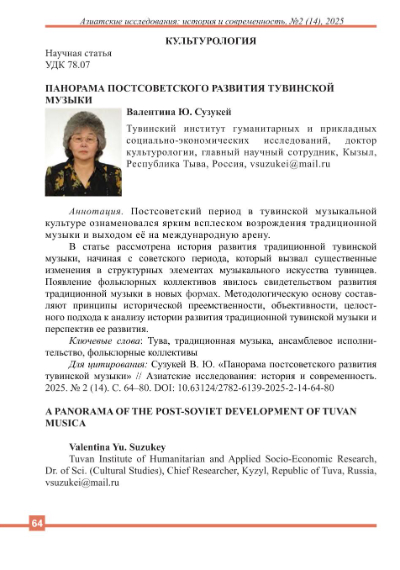
A PANORAMA OF THE POST-SOVIET DEVELOPMENT OF TUVAN MUSICA
The post-Soviet period in Tuvan musical culture was marked by a bright outburst of the flourishing of traditional music and its entry into the international arena. The article examines the history of the development of traditional Tuvan music, starting from the Soviet period, which caused significant changes in the structural elements of Tuvan musical art. The appearance of folklore groups was an evidence of the development of traditional music in new forms. The methodological basis of the article is relies on the principles of historical continuity, objectivity, and a holistic approach to analyzing the history of traditional Tuvan music and its development prospects.
Sociology
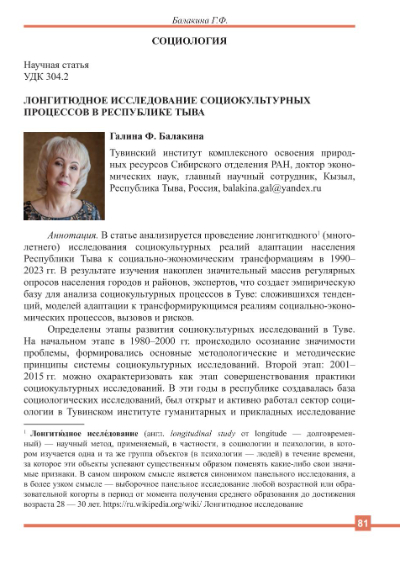
A LONGITUDINAL STUDY OF SOCIOCULTURAL PROCESSES IN THE REPUBLIC OF TUVA
The article analyzes the longitudinal (long-term) study of the socio-cultural realities of adaptation of the population of the Republic of Tuva to socio-economic transformations in 1990-2023. A significant array of regular surveys of the population of cities and districts, experts have been accumulated, which creates an empirical basis for the analysis of socio-cultural processes in Tuva: trends, models of adaptation to the transforming realities of socio-economic processes, challenges and risks. The author defines the stages of development of socio-cultural research in Tuva. At the initial stage in the 1980s - 2000, there was an awareness of the significance of the problem, researchers formed main methodological and methodological principles of investigating of the system of socio-cultural processes. The second stage: 2001-2015 can be characterized as a stage of improving the practice of socio-cultural research. During these years there was created a base for sociological research in the republic, the sociology sector was opened and actively worked at the Tuvan Institute of Humanitarian and Applied Sosial and Economic Research (TIHASER), employees of the Tuva State University (TuVSU) were involved in population surveys at the expense of contract and grant support. The third - modern stage - began in 2016 and continues to the present day. It is characterized by the expansion of the scope of socio-cultural analysis on the formed methodological base, developed terminological agreements. The study of socio-cultural processes is carried out by all leading scientific organizations of the region, including TuvSU, TIHASER and TuvIKOPR SB RAS. Possible directions of research of socio-cultural processes in the future are substantiated.
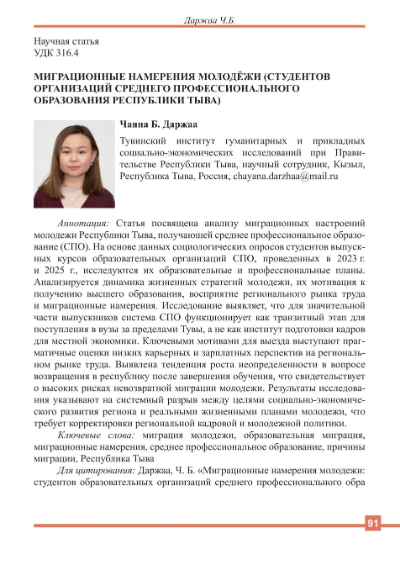
MIGRATION INTENTIONS OF YOUTH (STUDENTS OF SECONDARY VOCATIONAL EDUCATION ORGANIZATIONS OF THE REPUBLIC OF TUVA)
The article is dedicated to the analysis of migration attitudes among the youth of the Republic of Tuva who are receiving secondary vocational education (SVE). Based on the data from sociological surveys of final-year students from SVE institutions, conducted in 2023 and 2025, their educational and professional plans are examined. The dynamics of the youth’s life strategies, their motivation for pursuing higher education, their perception of the regional labor market, and their migration intentions are analyzed. The study reveals that for a significant portion of graduates, the SVE system functions as a transitional stage for entering universities outside of Tuva, rather than as an institution for training personnel for the local economy. The key motives for leaving are pragmatic assessments of low career and salary prospects in the regional labor market. A growing trend of uncertainty regarding returning to the republic after completing their studies has been identified, which indicates high risks of an irreversible youth migration. The research findings point to a systemic gap between the region’s socio-economic development goals and the actual life plans of the youth, which requires adjustments to the regional personnel and youth policies.
Translations
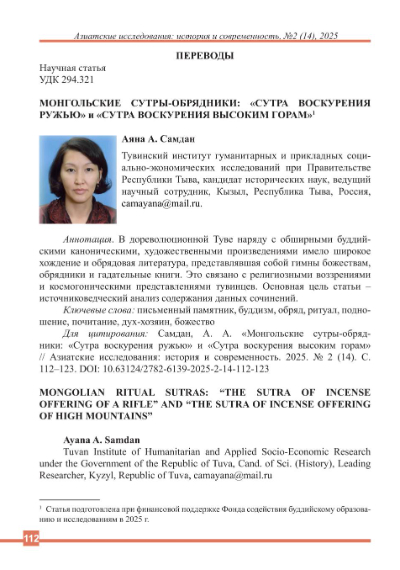
MONGOLIAN RITUAL SUTRAS: “THE SUTRA OF INCENSE OFFERING OF A RIFLE” AND “THE SUTRA OF INCENSE OFFERING OF HIGH MOUNTAINS”
In pre-revolutionary Tuva, along with extensive Buddhist canonical and artistic works, ritual literature was also widely used, which consisted of hymns to deities, rituals and fortune-telling books. This is due to the religious beliefs and cosmogonic beliefs of the Tuvinians. The main purpose of the article is a source–based analysis of the content of these sutras.
THE MONGOLIAN MANUSCRIPT “SUTRA-SANG (OFFERING) OF THE FOX” FROM TUVA: STRUCTURAL AND SEMANTIC FEATURES
The article is devoted to the analysis of the text of the manuscript of the Sutra-sang of the Resurrection of the Fox (orošiba Sutra-ü sang sudur) in the old-written Mongolian language, stored in the fund of Buddhist manuscripts and woodcuts of the Tuvan Institute of Humanitarian and Applied Socio-Economic Research under the Government of the Republic of Tuva. The author analyzes the features of Mongolian ritual texts, the history of the study of the sutra by Russian and foreign scholars, as well as the structure, content, semantics and origin of the text. The Buddhist, Tengrian-shamanic components and the ritual-ceremonial aspect of the sutra are highlighted. The cult of the fox and zoomorphic symbolism in the religion and culture of the peoples of Central and East Asia are studied. The conclusion is made about the Tibetan origin and syncretic character of the text.