Baylak C-O. Oorzhak (publ. also as Sotpa)

Publications by the Author
2 publications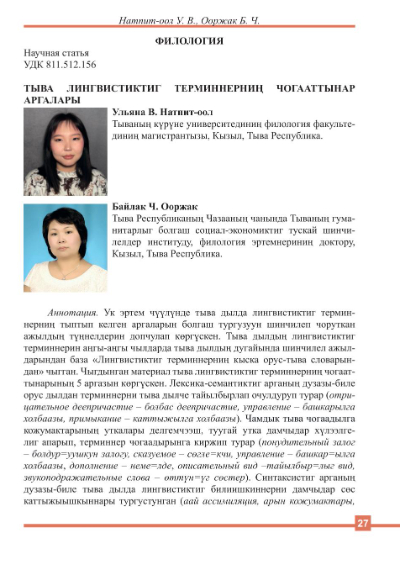
METHODS OF FORMING TUVAN LINGUISTIC TERMS
The scientific article presents the results of a study of the structure and methods of forming linguistic terms in the Tuvan language. The linguistic terms of the Tuvan language were extracted from studies on the Tuvan language published in different years, as well as from the “Brief Russian-Tuvan Dictionary of Linguistic Terms” [Sat, Mart-ool 2013]. The collected material revealed five methods of forming Tuvan linguistic terms. The lexical-semantic method involves the descriptive translation of Russian terms into Tuvan. The expansion of the meanings of some Tuvinian affixes, which begin to convey abstract meanings, allows them to participate in the creation of terms. The Tuvan language uses syntax to form phrases that convey complex linguistic concepts . The Tuvan linguistic terminology system has also been enriched by terms borrowed from the Russian language (or through the Russian language) by means of calque. Currently, borrowing terms from the Russian language is widely used as the main method of replenishing this system.
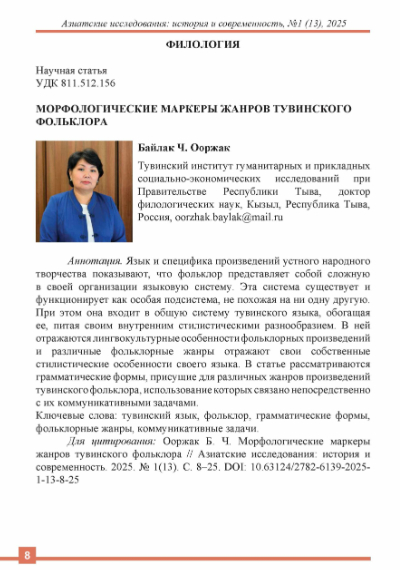
MORPHOLOGICAL MARKERS OF THE GENRES OF TUVAN FOLKLORE
The language and specifics of the oral folk show that folklore is a complex linguistic system in its organization. This system exists and functions as a special subsystem unlike any other. At the same time it enters into the general system of the Tuvan language, enriching and nourishing it with its internal stylistic diversity. It reflects the linguistic and cultural features of folklore and various folklore genres reflect their own stylistic features of their language. The article examines the grammatical forms inherent in various genres of Tuvan folklore works, the use of which is directly related to their communicative tasks.