Issue №2(18), 2026
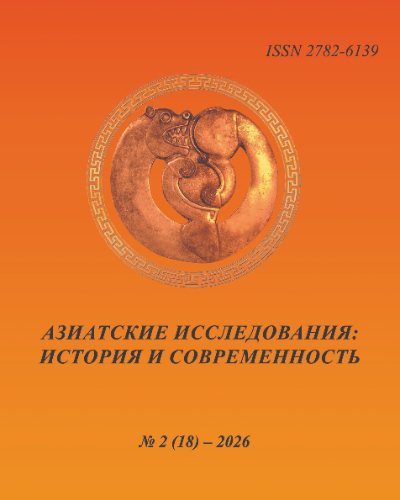
Issue №2(18)
- Year 2026
- Pages 157
- Published 14 May. 2026
- Views 353
- PDF downloads 103
- Permanent link to the issue https://asvestnik.ru/en/issue/2-18-2026
Articles in This Issue
10 itemsHistory
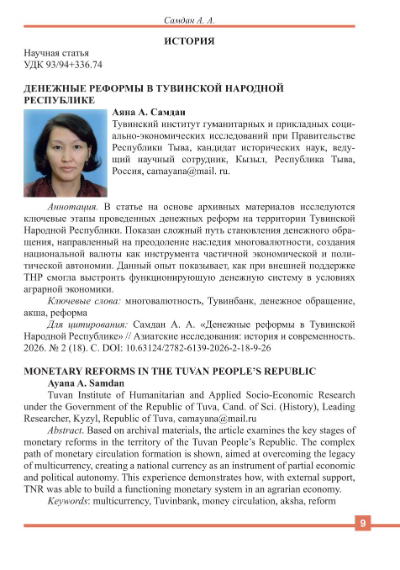
MONETARY REFORMS IN THE TUVAN PEOPLE’S REPUBLIC
Based on archival materials, the article examines the key stages of monetary reforms in the territory of the Tuvan People’s Republic. The complex path of monetary circulation formation is shown, aimed at overcoming the legacy of multicurrency, creating a national currency as an instrument of partial economic and political autonomy. This experience demonstrates how, with external support, TNR was able to build a functioning monetary system in an agrarian economy.
Philology
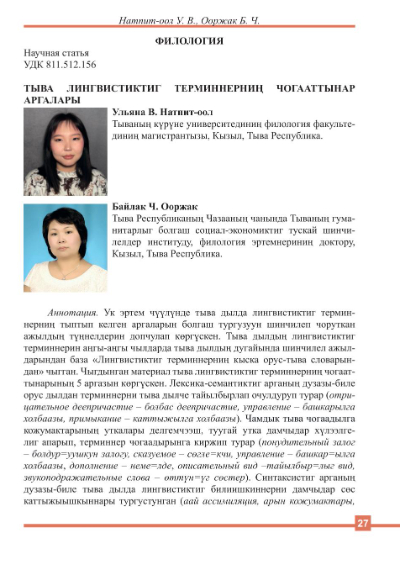
METHODS OF FORMING TUVAN LINGUISTIC TERMS
Ulyana V. Natpit-Ool , Baylak C-O. Oorzhak (publ. also as Sotpa)
The scientific article presents the results of a study of the structure and methods of forming linguistic terms in the Tuvan language. The linguistic terms of the Tuvan language were extracted from studies on the Tuvan language published in different years, as well as from the “Brief Russian-Tuvan Dictionary of Linguistic Terms” [Sat, Mart-ool 2013]. The collected material revealed five methods of forming Tuvan linguistic terms. The lexical-semantic method involves the descriptive translation of Russian terms into Tuvan. The expansion of the meanings of some Tuvinian affixes, which begin to convey abstract meanings, allows them to participate in the creation of terms. The Tuvan language uses syntax to form phrases that convey complex linguistic concepts . The Tuvan linguistic terminology system has also been enriched by terms borrowed from the Russian language (or through the Russian language) by means of calque. Currently, borrowing terms from the Russian language is widely used as the main method of replenishing this system.
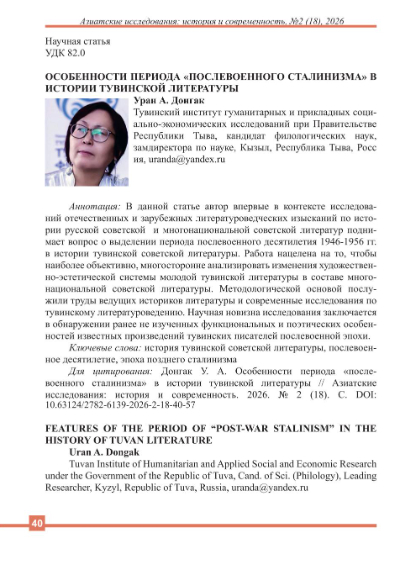
FEATURES OF THE PERIOD OF “POST-WAR STALINISM” IN THE HISTORY OF TUVAN LITERATURE
In this article, the author, for the first time, raises the question of identifying the postwar decade of 1946-1956 in the history of Tuvan Soviet literature within the context of domestic and international literary studies on the history of Russian Soviet literature. The work aims to objectively and comprehensively identify changes in the artistic and aesthetic system of young Tuvan literature within the context of multinational Soviet literature. The methodological basis is the works of leading literary historians and contemporary scholars of Tuvan literary studies. The scientific novelty of the study lies in the discovery of previously unexplored functional and poetic features of famous works by Tuvan writers of the postwar era.
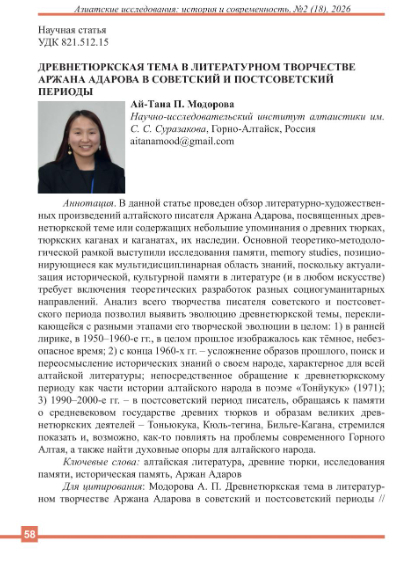
THE ANCIENT TURKIC THEME IN ARZHAN ADAROV’S LITERARY WORK IN THE SOVIET AND POST-SOVIET PERIODS
This article provides an overview of the literary and artistic works of the Altai writer Arzhan Adarov, devoted to the ancient Turkic theme or containing small references to the ancient Turks, Turkic khagans and kaganates, and their heritage. The main theoretical and methodological framework is memory studies, positioned as a multidisciplinary field of knowledge, since the actualization of historical and cultural memory in literature (and in any art) reflects a complex mechanism of group identification processes, for the study of which it is important to include theoretical developments from various socio-humanitarian fields. An analysis of the writer’s entire creative work from the Soviet and post-Soviet periods revealed the evolution of the ancient Turkic theme, echoing the stages of his creative evolution.: 1) in the early Poetry, in the 1950s and 1960s, the past was generally portrayed as a dark, unsafe time; 2) since the late 1960s, there has been a complication of images of the past, a search for and reinterpretation of historical knowledge about their people, characteristic of all Altaic literature; direct reference to the ancient Turkic period as part of the history of the Altaic people in the poem “Tonyukuk” (1971); 3) 1990–2000-ies – in the post-Soviet period, the writer, by appealing to the memory of the medieval state of the ancient Turks and to the images of great ancient Turkic figures – Tonyukuk, Kul-tegin, Bilge Kagan, sought to show and, perhaps, somehow influence the problems of modern Gorny Altai, also the writer sought to find spiritual supports for the Altai people.
Cultural studies
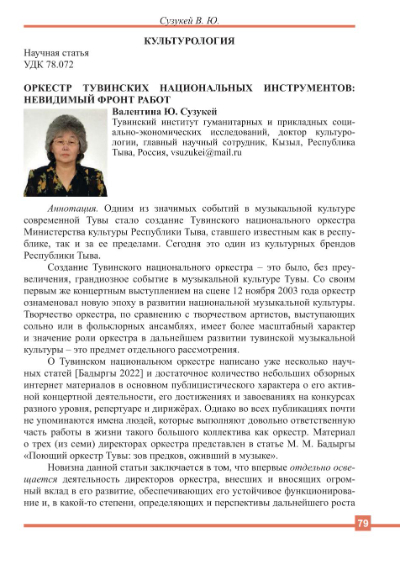
ORCHESTRA OF TUVAN NATIONAL INSTRUMENTS: AN INVISIBLE FRONT OF WORK
One of the significant events in the musical culture of modern Tuva was the creation of the Tuvan National Orchestra of the Ministry of Culture of the Republic of Tuva, which became famous both in the republic and abroad. Today it is one of the cultural brands of the Republic of Tuva. The creation of the Tuvan National Orchestra was, without exaggeration, a grandiose event in the musical culture of Tuva. With its first concert performance on stage on November 12, 2003, the orchestra marked a new era in the development of national musical culture. The work of the orchestra, in comparison with the work of artists performing solo or in folklore ensembles, has a larger scale and the importance of the orchestra’s role in the further development of Tuvan musical culture is a subject for separate consideration. Several scientific articles have already been written about the Tuvan National Orchestra and a sufficient number of small online review materials, mostly of a journalistic nature, about its active concert activities, about its achievements and achievements at competitions of various levels, about the repertoire, about the conductors. However, almost all publications do not mention the names of people who perform a rather responsible part of the work in the life of such a large band as the orchestra. There is information about three (out of seven) directors of the orchestra in M. M. Badyrgy’s article “The Singing Orchestra of Tuva: the call of the ancestors, revived in music.” The novelty of this article lies in the fact that, for the first time, the activities of the orchestra’s directors are separately highlighted, who have made and are making a huge contribution to the development of the orchestra, ensuring its sustainable functioning and, to some extent, determining the prospects for further growth and development of the collective. The material is based on archival materials collected by the orchestra’s deputy director J.A. Dorzhu.
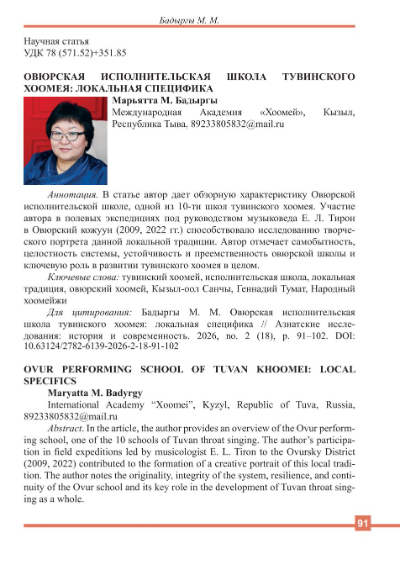
OVUR PERFORMING SCHOOL OF TUVAN KHOOMEI: LOCAL SPECIFICS
In the article, the author provides an overview of the Ovur performing school, one of the 10 schools of Tuvan throat singing. The author’s participation in field expeditions led by musicologist E. L. Tiron to the Ovursky District (2009, 2022) contributed to the formation of a creative portrait of this local tradition. The author notes the originality, integrity of the system, resilience, and continuity of the Ovur school and its key role in the development of Tuvan throat singing as a whole.
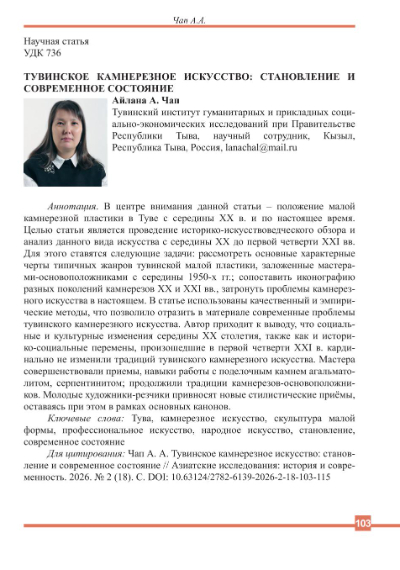
TUVAN STONE-CUTTING ART: FORMATION AND CURRENT STATE
The focus of this article is on the situation of small stone–cutting plastics in Tuva from the middle of the twentieth century to the present. The purpose of the article is to conduct a historical and art history review and analysis of this type of art from the middle of the twentieth century to the first quarter of the twenty-first century. For this purpose, the following tasks are set: to consider the main characteristic features of typical genres of Tuvan small sculpture, laid down by the founding masters since the mid-1950s; to compare the iconography of different generations of stonecutters of the XX-th and XXI st centuries, to touch upon the problems of stonecutting art in the present. The article uses qualitative and empirical methods, which made it possible to reflect in the material the modern problems of Tuvan stone-cutting art. The author comes to the conclusion that the social and cultural changes of the mid-twentieth century, as well as the historical and social changes that took place in the first quarter of the XXI st century, did not fundamentally change the traditions of Tuvan stone carving. The craftsmen improved the techniques and skills of working with ornamental stone agalmatolite, serpentinite; they continued the traditions of the founding stone carvers. Young carvers introduce new stylistic criteria, while remaining within the framework of the basic canons.
Demography of the region
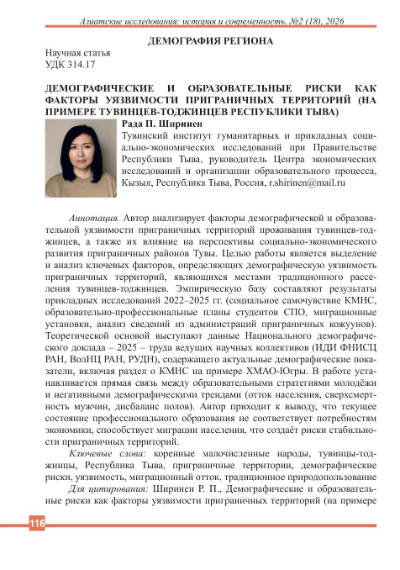
DEMOGRAPHIC AND EDUCATIONAL RISKS AS FACTORS OF VULNERABILITY IN THE BORDER TERRITORIES (ON THE EXAMPLE OF THE TUVAN-TODZHINS OF THE REPUBLIC OF TUVA)
Rada P. Shirinen (publ. also as Oorzhak)
The author analyzes the factors of demographic and educational vulnerability of the border territories inhabited by the Tuvan-Todzhins, as well as their impact on the prospects of socio-economic development of the border regions of Tuva. The purpose of this work is to identify and analyze the key factors determining the demographic and educational vulnerability of border territories inhabited by the Tuvans-Todzhins. The empirical basis consists of the results of applied research for 2022–2025 (social well-being of indigenous peoples, educational and professional plans of vocational students, migration attitudes, analysis of data from the administrations of border districts). The theoretical framework is the National Demographic Report – 2025, a work of leading research teams (IDI FNISTC RAS, VolSC RAS, RUDN University), which contains up-to-date demographic indicators, including a section on indigenous minorities on the example of Khanty-Mansiysk Autonomous Okrug – Ugra. The paper establishes a direct link between the educational strategies of young people and negative demographic trends (population outflow, male excess mortality, gender imbalance). The author concludes that the current state of vocational education not only fails to meet the needs of the economy, but also acts as a catalyst for the demographic crisis, threatening the stability of border territories. In this regard, a set of measures is proposed aimed at synchronizing educational, demographic and spatial policies.
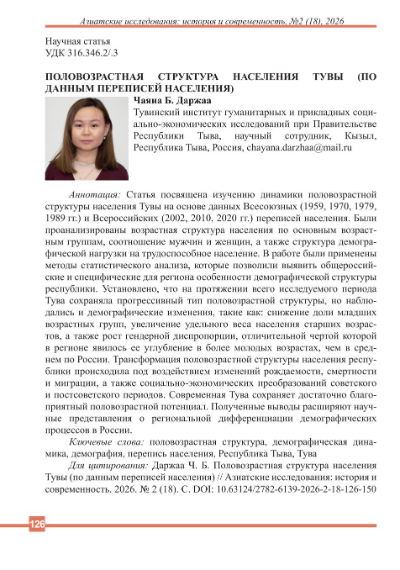
AGE-SEX STRUCTURE OF THE POPULATION OF TUVA (BASED ON CENSUS DATA)
The article is devoted to the analysis of the dynamics of the age-sex structure of the population of Tuva based on data from the All-Union population censuses (1959, 1970, 1979, 1989) and the All-Russian population censuses (2002, 2010, 2020). The analysis focuses on the population age structure by major age groups, the sex ratio, and the structure of the demographic dependency ratio. Statistical analysis methods were employed to identify both nationwide trends and demographic characteristics specific to the Republic of Tuva. The findings show that throughout the study period Tuva maintained a progressive age-sex population structure, while also experiencing substantial demographic changes, including a declining share of younger age groups, an increasing proportion of older people, and growing gender imbalance. A distinctive feature of the region is that gender imbalance becomes more pronounced at younger ages than the national average for Russia. Contemporary Tuva continues to retain a relatively favorable age-sex structure.
Reviews
![Article cover REVIEW OF THE MONOGRAPH: TIRON, E. L., BAYIR-OOL, A. V., TARBASTAEVA, I. S. THE SONG TRADITION OF THE OVYUR TUVANS IN THE CONTEXT OF RURAL-URBAN MIGRATION OF THE 21ST CENTURY, IN 2 PART, NOVOSIBIRSK, PPC OF NSU, 2023. PART 1. RESEARCHES, 300 P. [44], IL., PART 2, TEXTS, 732 P., [44] P. IL.](/files/journal/2-18-2026/151-157/cover-2-18-2026--151-157_9YrMD.jpg)
REVIEW OF THE MONOGRAPH: TIRON, E. L., BAYIR-OOL, A. V., TARBASTAEVA, I. S. THE SONG TRADITION OF THE OVYUR TUVANS IN THE CONTEXT OF RURAL-URBAN MIGRATION OF THE 21ST CENTURY, IN 2 PART, NOVOSIBIRSK, PPC OF NSU, 2023. PART 1. RESEARCHES, 300 P. [44], IL., PART 2, TEXTS, 732 P., [44] P. IL.
Mira V. Bavuu-Syuryun (publ. also as Oyun)
-