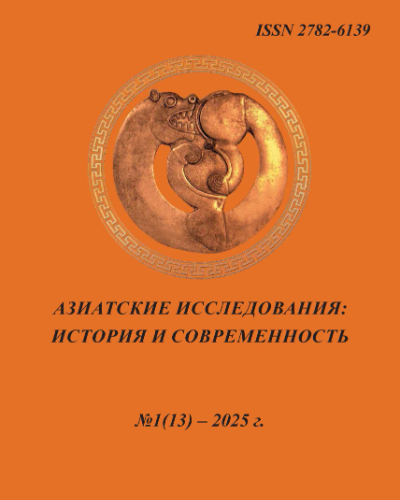
Issue №1(13), 2025
Issue №1(13)
- Year 2025
- Pages 116
- Published 11 Aug. 2025
- Views 194
- PDF downloads 118
- Permanent link to the issue https://asvestnik.ru/en/issue/1-13-2025
Articles in This Issue
7 itemsPhilology
MORPHOLOGICAL MARKERS OF THE GENRES OF TUVAN FOLKLORE
Baylak C-O. Oorzhak (publ. also as Sotpa)
The language and specifics of the oral folk show that folklore is a complex linguistic system in its organization. This system exists and functions as a special subsystem unlike any other. At the same time it enters into the general system of the Tuvan language, enriching and nourishing it with its internal stylistic diversity. It reflects the linguistic and cultural features of folklore and various folklore genres reflect their own stylistic features of their language. The article examines the grammatical forms inherent in various genres of Tuvan folklore works, the use of which is directly related to their communicative tasks.
FOLKLORE AS A SOURCE OF REPLENISHMENT OF EXPRESSIVE VOCABULARY IN THE TUVAN LANGUAGE
This article explores metaphorical expressions as part of the expressive lexicon in Tuvan. It examines how semantic derivation contributes to the expressive vocabulary. Language naturally economizes, often relying on metaphor for expressive naming. Myths, fairy tales, heroic epics, and shamanic chants (algysh), are significant source of expressive vocabulary in Tuvan. Characters and mythical creatures from these sources are frequently used to describe people. While these expressions lack explicit markers of expressivity, native speakers intuitively recognize their expressive potential. The imagery embedded in these connotative meanings can convey positive or negative assessments. Metaphorical expressions serve as versatile tools for expressing emotional attitudes and social judgments. The article provides examples illustrating how words acquire new meanings through semantic derivation, expand their semantic scope, and are analyzed and compared. The analysis reveals that certain lexical bases are productive, generating new words and phrases in contemporary Tuvan and being actively used in everyday speech. Interestingly, the gender of the mythical creature from which these expressive words originate does not always determine their usage. Folklore thus emerges as a rich reservoir of expressive vocabulary, highlighting the expressiveness of the Tuvan language.
NAMES OF COLORS OF DOMESTIC ANIMALS IN THE SPEECH OF TSENGEL TUVANS
The author attempts to introduce, as far as possible, the peculiarities of the vocabulary associated with the colors of domestic animals in the speech of the Tsengel Tuvans in comparison with the Tuvan literary language and its dialects, as well as with the Turkic and Mongolian languages. The results of the research can be used in further study of the lexicology and dialectology of the Tuvan language and can also serve as material for historical-etymological, comparative-contrastive, dialectological, and industry-specific dictionaries of the Tuvan language.
SYNTAGMATIC RELATIONS IN THE LEXICO-SEMANTIC FIELD CENTERED AROUND THE WORD KARA ‘BLACK, DARK’ (based on Tuvan folk songs)
The article examines the syntagmatic relations of the lexeme kara (‘dear’) in examples selected from Tuvan folk song texts. The semantic characteristics of the Tuvan adjective kara (‘black’) in the meaning of ‘dear’ are explored within a socio-communicative context. The primary focus of the study is the combinatory potential of the lexeme kara (‘dear’) with other parts of speech. The analysis employs statistical and contextual methods. The source material consists of Tuvan folk songs published in various collections and scholarly works. The study identifies the most and least frequent words that co-occur with kara (‘dear’). The analysis reveals that the lexeme kara most frequently forms attributive phrases with adjectives, izafet constructions with substantives, and verbal combinations. Mediumfrequency collocations include those with motion verbs and pronouns, while the least frequent are combinations with the particle chok. The frequency of each individual collocation is also determined. Thus, the word kara (‘darkskinned/dark beauty > dear/beloved’) is actively used in Tuvan folk love lyric songs. The lexeme exhibits a distinct range of syntagmatic relations, the intensity of which is determined by the thematic content of the songs themselves.
ON THE ORONYM OF TUGLUGA AND MICROTOPONYMY OF ITS SURROUNDINGS
The origin of the toponym Tugluga is controversial. This sacred mountain, traditionally perceived as the place where the sun “is born” every morning, has become an important part of the spiritual culture of the local population. Despite its sacred significance, the name of the mountain is not recorded in written sources. The article examines several versions of the origin of this toponym. The most probable version for researchers is its connection with the Mongolian lexeme tugalga – “mountain of lead color.” However, the author leans towards the hypothesis that the name is based on the polysemous word tolgoy, which is also found in the toponym TsagaanTolgoy (In Tuvan Ak-Bedik). During the research, it was discovered that the word had been mistakenly interpreted and translated into Russian in the text of the well-known folk song “The Nut Forest.” This study aims to identify the motivation behind the naming of the mountain, its connection to the historical context, and its spiritual and cultural significance, which grows with each passing day and becomes increasingly important for the local population.
THE ACTUAL DIVISION OF SENTENCES WITH A NOMINAL PREDICATE IN THE TUVAN LANGUAGE
Choygan G. Ondar , Salbak R. Chalbak
The communicative structure of a sentence in the Tuvan language remains an almost unexplored area of linguistics, despite its importance for understanding the functional and pragmatic features of the language. This article provides a systematic analysis of the actual division of sentences with a nominal predicate based on the material of literary texts and newspaper articles. Special attention is paid to the ways of expressing themes and rhymes, the order of words, as well as the role of particles in shaping the communicative perspective of an utterance. The conducted research makes it possible to identify the specifics of the functioning of the nominal predicate in various communicative contexts, which contributes not only to the study of Tuvan syntax, but also to the typology of Turkic languages. The results of the investigation can be used in further work on grammar, discursive analysis and teaching of the Tuvan language.
Personalities
THIRTY-FIVE YEARS OF SCIENTIFIC ACTIVITY (TO THE 70TH ANNIVERSARY OF MOLLEROV, NIKOLAI MIKHAILOVICH)
The article is devoted to the review of the research and teaching activities of Doctor of Historical Sciences, Honored Scientist of the Republic of Tuva Nikolay Mikhailovich Mollerov. He is a major researcher on the modern period of Tuva history. His works are devoted to a wide range of socio-political problems of Tuva in the 20th century. In addition, publications of archival documents occupy a special place in the list of scientifi c works of N.M. Mollerov.