Organa D. Natsak

Publications by the Author
8 publications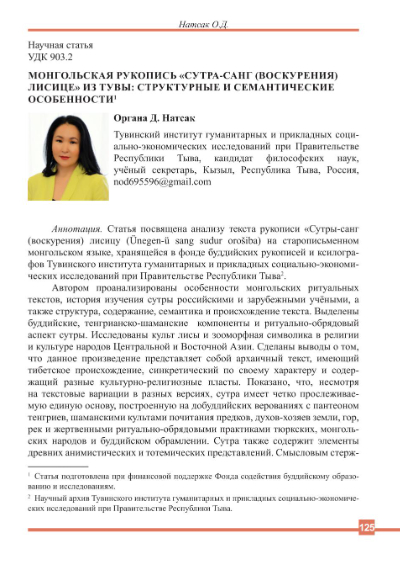
THE MONGOLIAN MANUSCRIPT “SUTRA-SANG (OFFERING) OF THE FOX” FROM TUVA: STRUCTURAL AND SEMANTIC FEATURES
The article is devoted to the analysis of the text of the manuscript of the Sutra-sang of the Resurrection of the Fox (orošiba Sutra-ü sang sudur) in the old-written Mongolian language, stored in the fund of Buddhist manuscripts and woodcuts of the Tuvan Institute of Humanitarian and Applied Socio-Economic Research under the Government of the Republic of Tuva. The author analyzes the features of Mongolian ritual texts, the history of the study of the sutra by Russian and foreign scholars, as well as the structure, content, semantics and origin of the text. The Buddhist, Tengrian-shamanic components and the ritual-ceremonial aspect of the sutra are highlighted. The cult of the fox and zoomorphic symbolism in the religion and culture of the peoples of Central and East Asia are studied. The conclusion is made about the Tibetan origin and syncretic character of the text.
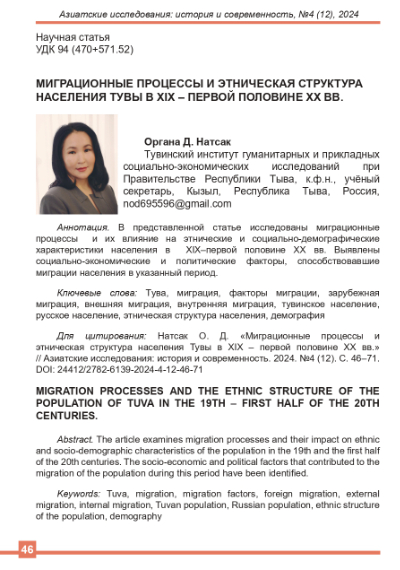
MIGRATION PROCESSES AND THE ETHNIC STRUCTURE OF THE POPULATION OF TUVA IN THE 19TH – FIRST HALF OF THE 20TH CENTURIES.
The article examines migration processes and their impact on ethnic and socio-demographic characteristics of the population in the 19th and the first half of the 20th centuries. The socio-economic and political factors that contributed to the migration of the population during this period have been identified.
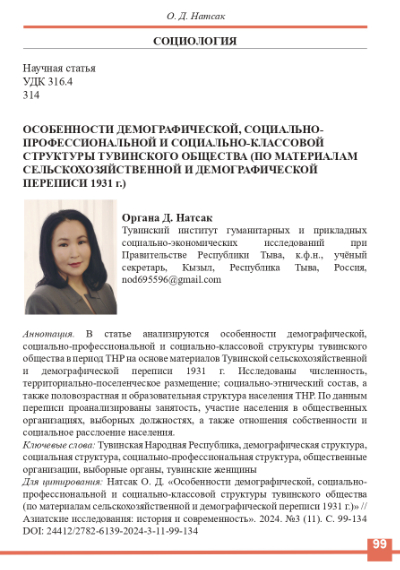
FEATURES OF THE DEMOGRAPHIC, SOCIO-PROFESSIONAL AND SOCIO-CLASS STRUCTURE OF TUVAN SOCIETY (THE MATERIALS OF THE AGRICULTURAL AND DEMOGRAPHIC CENSUS OF 1931)
The article analyzes the features of the demographic, socio-professional and socio-class structure of Tuvan society in the period of the Tuvan People’s Republic on the base of materials of the Tuvan Agricultural and Demographic Census of 1931. The author has investigated number, territorial settlement, socio-ethnic composition, as well as the gender, age and educational structure of the population of the TNR. There is an analysis of employment, participation of the population in public organizations, elected positions, as well as property relations and social stratification of the population.
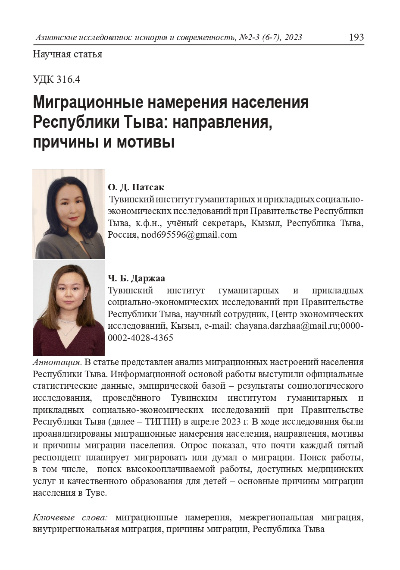
MIGRATION INTENTIONS OF THE POPULATION OF THE REPUBLIC OF TUVA: DIRECTIONS, REASONS AND MOTIVES
The article presents an analysis of migration attitudes of the population of the Republic of Tuva. The authors have used official statistical data and the results of a sociological survey conducted by the Tuvan Institute for Humanitarian and Applied Socio-Economic Research under the Government of the Republic of Tuva (hereinafter - TIGPI) in April 2023 as informational and empirical base of the article. Migration intentions, directions, motives and causes of migration of the population have become the subject of analysis. The survey showed that almost every fifth respondent plans to migrate or thought about migration. Job search, including the search for a well-paid job, affordable medical services and quality education for children are the main reasons for the migration of the population in Tuva.

BUDDISM AND WOMEN IN TUVAN SOCIETY (HISTORICAL AND SOCIOLOGICAL ANALYSIS)
The article investigates the evolution of the and role of women in Buddhism under the influence of changes in cultural tradition in different political, social and spiritual conditions of the historical development of Tuva. The author presents an analysis of the features of women's involvement in socio-religious processes in the Qing period, in the Tuvan People's Republic (TPR), in Soviet and post-Soviet times. The political discourse of anti-religious propaganda among women during the TNR period is described as part of the tactics of the struggle against lamas and religion. It is concluded that only at the present stage women in Tuva have the opportunity to become full participants in the processes in the religious sphere, to comprehend and transmit Buddhist values in the family and society.

WOMEN'S ISSUE IN TUVA AND MONGOLIA IN THE 1920S AND 1930S.
The author analyzes general political origins of approaches to the women's issue, content, forms and methods of working with women in the Tuvan People's Republic (TPR) and the Mongolian People's Republic (MPR) in 1920-1930, taking into account the internal political situation in two countries. The paper concludes that the Communist International played a significant role in including the women’s issue in the political agenda of the People's revolutionary parties in the TPR and MPR, as well as in the formation of an organizational model of work with women. The author reveals Tuvan-Mongolian relations at the level of departments for working with women, created under the Central Committees of the Tuvan National-revolutionary Party and the Mongolian National-revolutionary Party. As a result of the conducted research, it is concluded that political enlightenment, the involvement of Tuvan and Mongolian women in education and culture, sanitary and hygienic knowledge and modern medicine, as well as transformation of everyday life have become the fundamental basis for the further emancipation of women and the achievement of de facto gender equality. From this point of view, the period under review was the most important stage in the formation of a new image of women and new social practices in the nomadic societies of Tuva and Mongolia.
-2022--25-54_nTXk7.jpg)
THE TERE-KHOLSKY MUTINY IN TUVA (1932)
The article is devoted to an unsufficiently studied issue in Tuvan historiography related to the armed uprising in Tere-Hol in 1932: the internal political aspect and causes, the course of events, the social composition of participants, the cross-border nature and political lessons of the mutiny.
The author shows that Tere-Khol armed action was directed against the policies of the party and the government, in defense of religion, and has an anti-modernizing nature. The social composition of the participants indicates that they were not only former feudal lords and lamas, whose economic and political situation worsened as a result of “leftist politics”, but also arats, party and Komsomol workers, representatives of local authorities. Like the mutiny on Khemchik in 1930, the incident in Tere-Khol had a cross-border character, coincided in time with the Khubsugul uprising in Mongolia.
It had been the last manifestation of an open form of resistance and opposition to the policies of the party and government in the TPR after which there was no armed political protest in the TPR.
FOREIGN AND DOMESTIC POLITICAL FACTORS IN THE EMERGENCE OF THE ARMED UPRISING ON KHEMCHIK IN 1930
The article examines the complex of external and internal political factors that influenced the emergence of the armed uprising in Khemchik in 1930. The author concludes that the radical and accelerated implementation of the “left course” dictated from the outside, the fight against the “right bias” at the level of public administration and the party, and as a consequence - the removal from power of former feudal lords and lamas, discussions of the impending confiscation of the property of former feudal lords and lamas, the acceleration of collectivization have become defining domestic political events that have affected the aggravation of the socio-political conflict between the government, the party, on the one hand, and the former elites, ordinary arats, on the other. No less important were such events as the deprivation of political (electoral) rights of former feudal lords and lamas on the basis of class and status affiliation, the separation of the Buddhist church from the state and activation of anti-religious policy and the legislative prohibition of admission to monastic education of persons under 18, and as well as the use of economic pressure measures on the economic system of monasteries through the policy of differentiated taxation. The author reveals the role of political rumors, in particular, rumors about the arrival of the Panchen-Bogdo.