Issue №2(2), 2022
Issue №2(2)
- Year 2022
- Pages 159
- Published 26 Jun. 2022
- Views 310
- PDF downloads 0
- Permanent link to the issue https://asvestnik.ru/en/issue/2-2-2022
Articles in This Issue
9 itemsHistory
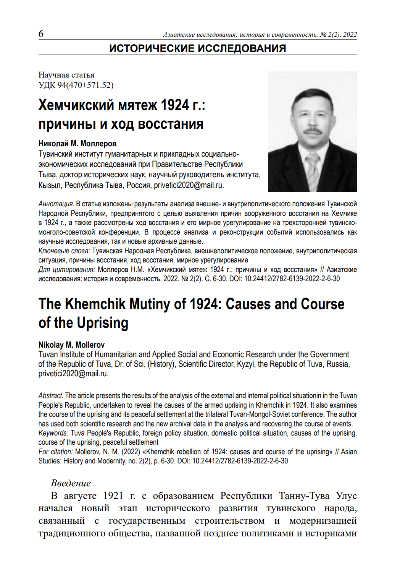
THE KHEMCHIK MUTINY OF 1924: CAUSES AND COURSE OF THE UPRISING
The article presents the results of the analysis of the external and internal political situationin in the Tuvan People's Republic, undertaken to reveal the causes of the armed uprising in Khemchik in 1924. It also examines the course of the uprising and its peaceful settlement at the trilateral Tuvan-Mongol-Soviet conference. The author has used both scientific research and the new archival data in the analysis and recovering the course of events.
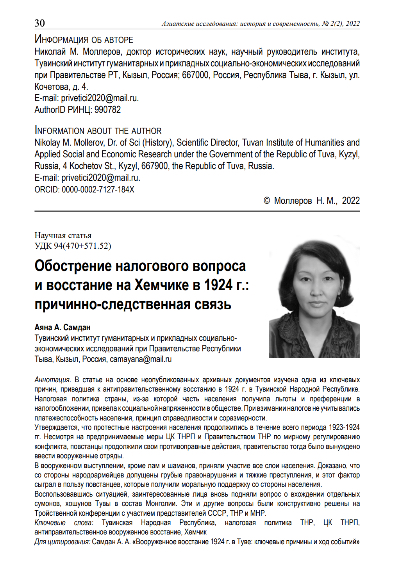
AGGRAVATION OF THE TAX ISSUE AND THE UPRISING ON KHEMCHIK IN 1924: A CAUSAL RELATIONSHIP
The article examines the key factors that led to the anti-government uprising in 1924 in the Tuvan People's Republic (the TPR) on the basis of unpublished archival documents. The tax policy of the country, due to which part of the population received benefits and preferences in taxation, led to social tension in society. When collecting taxes the solvency of the population, the principle of fairness and proportionality were not taken into account. It is claimed that the protest mood of the population continued throughout 1923-1924. Despite the measures taken by the Tuvan People's Republic Party’s Central Committee and the TPR Government to peacefully regulate the conflict, the rebels continued their illegal actions. Then they were forced to do armed detachments. All segments of the population, except lamas and shamans, took part in the armed demonstration. It is proved that gross offenses and serious crimes were committed by the People's Army. That factor played to the rebels’ advantages who received moral support from the population. Taking advantage of the situation interested persons again raised the issue of the entry of some Tuvan sumons, khoshuns into Mongolia. Those and other issues were resolved constructively at the Tripartite Conference with the participation of representatives of the USSR, the TPR and MPR (Mongolian People's Republic).
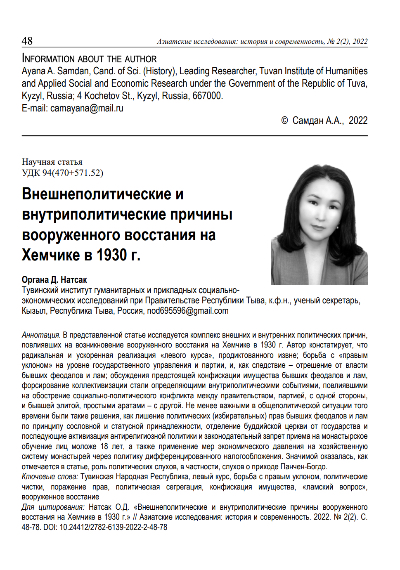
FOREIGN AND DOMESTIC POLITICAL FACTORS IN THE EMERGENCE OF THE ARMED UPRISING ON KHEMCHIK IN 1930
The article examines the complex of external and internal political factors that influenced the emergence of the armed uprising in Khemchik in 1930. The author concludes that the radical and accelerated implementation of the “left course” dictated from the outside, the fight against the “right bias” at the level of public administration and the party, and as a consequence - the removal from power of former feudal lords and lamas, discussions of the impending confiscation of the property of former feudal lords and lamas, the acceleration of collectivization have become defining domestic political events that have affected the aggravation of the socio-political conflict between the government, the party, on the one hand, and the former elites, ordinary arats, on the other. No less important were such events as the deprivation of political (electoral) rights of former feudal lords and lamas on the basis of class and status affiliation, the separation of the Buddhist church from the state and activation of anti-religious policy and the legislative prohibition of admission to monastic education of persons under 18, and as well as the use of economic pressure measures on the economic system of monasteries through the policy of differentiated taxation. The author reveals the role of political rumors, in particular, rumors about the arrival of the Panchen-Bogdo.
ENTREPRENEURIAL ACTIVITY OF REPRESENTATIVES OF THE AUTHORITIES OF MINUSINSK IN THE URIANKHAI REGION (THE SECOND HALF OF THE XIX CENTURY)
The article examines personalities from among the residents of the city of Minusinsk, who were engaged in entrepreneurial activities on the territory of Tuva in the second half of the 19th century. The author refers to less studied material in the history of the Minusinsk district of the Yenisei province and the Uryankhai region - the activities of entrepreneurs who were part of the Minusinsk City Duma.
Philology

THE THEME OF LENIN AND OCTOBER REVOLUTION AS THE CULTURAL CANONS OF SOCIALIST REALIST ART IN TUVAN POETRY
The article considers the issue of the formation and development of Tuvan literature in the context of totalitarian art. From the standpoint of the aesthetics of socialist realism, the cultural canons of socialist realism are revealed in the works of Tuvan poets. Then such concepts as ritualism, rhetoricalness, self-censorship, doublethink and double-layeredness in fictional work are explained. Starting from the first years of the formation of Tuvan national literature (1927-1930) appeal to the topic of the conquests of the socialist revolution, to the theme of Lenin and October revolution, the praise of Stalin as the great leader of the peoples become mandatory, ritual, canonized components of the Tuvan Soviet literature. The theme of Lenin and October revolution in the Tuvan literature of the Soviet period was a leading topic until the end of the 1970s. The dominant of the poetic works of the Tuvan poets throughout the Soviet period is the concept of happiness expressed by the words “aas-kezhik” (happiness), “kezhik” (luck), “chyrgal” (bliss, paradise), “chyrgalang” (paradise life) accumulating aesthetic ideal of the era. The poetic collections of the Tuvan poets and the editions of the almanac “Ulug-Khem” invariably opened by the section including these “common places”. As a means of literary self-reflection literary works and criticism analyzed works primarily in a given angle. In the article, the author focuses on the analytical tools of the substantial plan (topic, “common places”, canon, aesthetic ideal), as well as the chronological perspective of the study of Tuvan Soviet literature. The period of 1940s -1970s is pre-designated as the heyday of socialist realism in Tuvan literature; the 1980s are the transitional period accumulating new meanings and expressive forms. The 1990s were defined as the completion of the hegemony of socialist realism marked with the scene postmodernism carrying a free from ideologized art new trend. The author also emphasizes the importance of understanding the worldview foundation of the distinguished cultural canons, aesthetic ideal captured in works as well as the transitional state of literature from the traditionalist poetry to poetics of artistic modality.
Socio-economic research

THE SOVIET FACTOR IN THE SPATIAL AND ECONOMIC DEVELOPMENT OF THE TPR
The author taking into account the relevance of the problem of a qualitatively new organization of the regional socio-economic space of Russia and its regions, has made an attempt to determine possible priority actions in accordance with new requirements for the organization of spatial development. The author considers that it is important to pay attention to traditional features and needs of the population of modern Tuva.
THE RAILWAY TO TUVA: A DEAD-END TECHNOLOGICAL BRANCH OR A CROSS-BORDER CORRIDOR THAT ENSURES THE TURN OF THE RUSSIAN ECONOMY TO THE EAST
The Republic of Tuva is one of the few subjects of the Russian Federation where there has never been a railway line. This fact complicates the development of natural resources and, in general, it slows down the development of the region’s economy. Several attempts to resolve the issue of connecting Tuva with the country's rail network ended in vain. In the conditions of a fundamental turn of the Russian economy to the East, it is possible to return to the issue of the construction of the Kyzyl-Kuragino road as a part of the Russia - Mongolia - China cross-border transport corridor.
UBSUNUR 2.0 AS A NEW PROJECT OF CROSS-BORDER SCIENTIFIC AND TECHNICAL INTERACTIONS
Vyacheslav E. Seliverstov , Choygan N. Sambyla , Aydys P. Temir-ool
The article shows the role and importance of cross-border economic, scientific and technical interactions for strengthening the eastern vector of spatial development of Russia, especially Siberia and the Far East. The Republic of Tuva, being an integral spatial part of Siberia, can become not only a transit and transport link in the logistics systems of Russia, Mongolia and China, but it also can be a full-fledged participant in international and interregional value chains. Such integration of Tuva into cross-border interactions will ensure sustainable development, realize all the rich natural resource, historical and cultural potential of this unique territory. One of the most striking examples of cross-border scientific and technical cooperation is the launch of the international program “Experiment Ubsunur” in the early 90s. Its mission was to study and preserve the natural, cultural and historical heritage of the trans-border Ubsunur basin and ecosystems of Central Asia. Definitely the implementation of the “Ubsunur Experiment” program made a significant contribution to the development of science and innovation in Tuva in the late 20th - early 21st centuries. Accumulated scientific potential of the Republic of Tuva makes it possible to start implementing the updated “Ubsunur 2.0” program. The last program is focused on continuing the development of the Ubsunur International Center for Biosphere Research taking into account modern opportunities, challenges and threats.
Cultural studies
ORIGIN, DEVELOPMENT AND EVOLUTION OF THE MUSICAL INSTRUMENT “SHOOR”
This article uses folklore materials collected by the author for studying the different social roles of the Tuvan musical wind instrument shoor in different historical periods in the life of ethnic Tuvans living in the Altai aimag of the Ili-Kazakh Autonomous Region of the Xinjiang Uygur Autonomous Region of China. Moreover, the author explores the origin, development and evolution of the given musical instrument, and also points to the social causes of the problem of inheritance of playing the shoor. The study has been carried out by the author over many years. The author is also one of the last owners of the fine art of playing this musical instrument. The result of the author's many years of work on this study was an extensive article published in Chinese in 2012.