Issue №2-3(6-7), 2023

Issue №2-3(6-7)
- Year 2023
- Pages 234
- Published 24 Mar. 2023
- Views 360
- PDF downloads 168
- Permanent link to the issue https://asvestnik.ru/en/issue/2-3-6-7-2023
Articles in This Issue
14 itemsHistory
POLITICAL MYTHS OF THE MODERN HISTORY OF TUVA (THE SOVIET PERIOD)
The article reveals two mythical "whales" of historical Tuvan studies: the false identity of the concepts of "patronage" and "accession" and the biggest political myth of the modern history of Tuva - the ghost of the people's revolution. These myths laid in the foundation of the concept of the modern history of Tuva and caused its amorphousness and inconsistency.

LOPSAN SOTPAEVICH SALCHAK (1909-1965) AS A LINGUIST SCIENTIST OF THE TUVAN PEOPLE'S REPUBLIC
The article is dedicated to one of the first representatives of the Tuvan intelligentsia, the scholar-linguist of the Tuvan People's Republic Lopsan Sotpaevich Salchak, whose 115th anniversary will be celebrated in April 2024. The author comes to the conclusion that Lopsan Salchak played a significant role in the history of Tuva, becoming one of the compilers of Tuvan Latinized alphabet. S. S. Lopsan was involved in translating many books and textbooks into the Tuvan language. His works today are of great historical and cultural value. Archives of S. S. Lopsana are stored as valuable materials in the National Archive and the Aldan-Maadyr National Museum of the Republic of Tuva, in the scientific archive of the Tuvan Institute of Humanitarian and Applied Social and Economic Research under the Government of the Republic of Tuva
Archaeology
PRELIMINARY RESULTS OF ARCHAEOLOGICAL EXPLORING IN THE CHEDI-KHOL KOZHUUN OF THE REPUBLIC OF TUVA IN 2023
Larisa D-O. Chadamba , Mergen A. Mongush , Kezhik M-O. Mongush
The article presents the preliminary results of the archaeological exploring carried out in 2023 by the Center for Archaeological Research of the Tuvan Institute of Humanities and Applied Socio-Economic Research (hereinafter TSAI TIGPI) in the vicinity of the village of Ak-Tal Chedi-Khol kozhuun of the Republic of Tuva. The archaeological exploring was a continuation of the research on the territory of the Chedi-Khol kozhuun, which began in 2022 [Chadamba, Kuular, 2022, p. 55-62]. The archaeological works were aimed at searching for previously unknown objects, the subsequent task of putting them on state registration. As a result, we have identified several archaeological sites of different types and clarified the boundaries of the territories of previously known objects: the ancient Turkic fence with a statue, the Suzugu-1 burial mound, the Uzun-Hovu-1 settlement in the Kes-Aryg tract. Also, as part of our research, two previously unknown locations of petroglyphs located in the upper reaches of the Elegest and Henderge rivers were examined and studied. A comprehensive analysis of the materials obtained allowed the authors to conclude that the specified microdistrict is very promising in archaeological terms.
Philology
RESEARCH ISSUES OF THE HISTORICAL POETICS OF TUVAN LITERATURE
The article is devoted to the study of historical poetics of Tuvan literature. The author, relying on the research of Russian literary critics on the three types of artistic consciousness in the history of the so-called “big time”, draws attention to the forms of manifestation of archaic, traditionalist and individually creative poetics in the evolution of artistic and visual media in the history of Tuvan literature. Based on the material of the works of classics of Tuvan literature, the article analyzes various aspects of historical poetics: the formation of the category of authorship, genre blurriness and new genre forms, stylistic complexity of new art (innovations in versification, etc.). Thus, in the reconstruction of archaic poetics, the origins of the most important artistic properties of Tuvan literature are revealed. The background of the identification of the category "author", for example, is recorded in shamanic texts. Genre distinction begins to manifest itself in the rules of ritual and etiquette, for example, in the etiquette of guessing - solving riddles - tyvyzk in the Tuvan folklore tradition (baazhyz). The artistic heritage of D. Barykan is defined as a transitional period in the origin of Tuvan national literature: from folklore to literature, from traditionalist artistic consciousness to individual authorship, which consolidated the phenomenon of literary thinking in Tuva. The poetics of traditionalist, on the one hand, and socialist realism, on the other, is most vividly reflected in the structure of the first poetic works of Tuvan authors included in the collection of 1939. Active manifestations of the category "author" in the poetics of new poetic works indicate the intensity of penetration into the works of poetics of artistic modality already at the initial stage of the history of Tuvan literature.
THE INFLUENCE OF S. PURBU’S LITERARY TRANSLATIONS ON THE DEVELOPMENT OF THE TUVAN LANGUAGE
This article analyzes the features of S. Purby's translation of some works of outstanding writers of Russian classical and foreign literature: a novel in verse by A. S. Pushkin “Eugene Onegin”, historical story by L. N. Tolstoy's "Hadji Murat", tragedy by W. Shakespeare "Romeo and Juliet". The translation activity of S. Purby is presented in two periods: translations during the period of the Tuvan People's Republic and translations during the period of Soviet Tuva. Here we examine some unexplained aspects of the translation activity of a repressed writer during the period of Soviet Tuva: Purby translated from Russian into the Tuvan language, as well as from Tuvan into Russian (much less often) works of a wide variety of literary genres (novel in verse, novel, tragedy, story, story, lyrical song, civil lyrics, plays). The author also considered the example of an analysis of the Tuvan translation of S. Purby to determine that the poet masterfully used adequate and free types of translation. To more accurately convey the content of his works, he used the following types of vocabulary introduction: names of flowers and various plants in the Tuvan language, borrowed vocabulary; adequate translation of simple epithets - simple epithets, complex epithets - complex, personification - personification, metaphor - direct name, etc. The author notes such an important fact as the prohibition of the name of the translator during the years of imprisonment of the writer S. B. Purby in Angarlag.
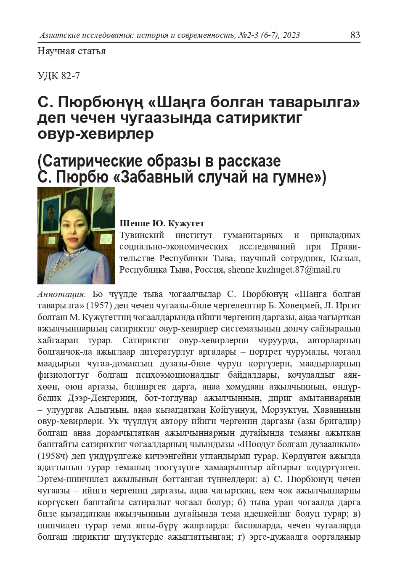
SATIRICAL IMAGES IN S. PURBU'S STORY “A FUNNY INCIDENT ON THE THRESHING FLOOR”
Shenne Y. Khomushku (publ. also as Kuzhuget)
This article examines the satirical images of a foreman and offended subordinates in the satirical story by S. Purby “Shaoga bolgan tavarylga” (“A funny incident on the threshing floor”, 1957) in comparison with the works of other Tuvan writers as B. Hovenmey, L. Irgit , M. Kuzhuget, in particular, literary techniques often used by writers to create satirical images - description of a portrait, speech characteristics, physiological and psycho-emotional state of characters, ironic pathos, artistic technique of play, images of arrogant bosses and insulted subordinates, Heaven (Deer-Denger) and an arrogant employee, animals - the domineering Bear and the oppressed Hare, Badger, Pig. The author refered to the publication “Shoodug bolgash duzaashkyn” (“Satire and humor” in Tuvan) (1958), in which the theme of a foreman and oppressed subordinates had been described. The author of the article concludes that the story of S. Purby was the first satirical work about the boss and subordinates, the theme of superior and subordinate was very popular in Tuvan literature and continues to be relevant in modern Tuvan literature.
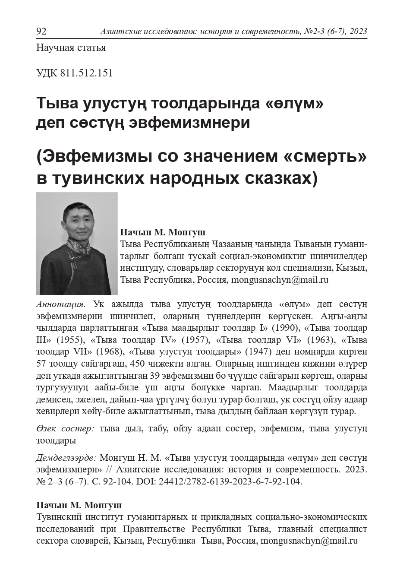
EUPHEMISMS WITH THE MEANING OF "DEATH" IN TUVAN FOLK TALES
The article presents the results of a study of euphemisms with the meaning of death "olum" in Tuvan folk tales. The author has collected 450 examples from 57 fairy tales published in books such as “Tyva maadyrlyg tooldar I” (1990), “Tyva tooldar III” (1955), “Tyva tooldar IV” (1957), “Tyva tooldar VI” (1963), “Tyva tooldar VII” (1968), “Tyva ulustun tooldary” (1947). Only 39 of them - euphemisms expressing the meaning of "to kill a person" have been analyzed by the athor in the article. The values of the collected euphemisms are determined and their classification by structure is carried out. In heroic fairy tales, struggle and conquest always prevail, therefore, allegories of this word are often found, which proves the richness of the Tuvan language.
Ethnography
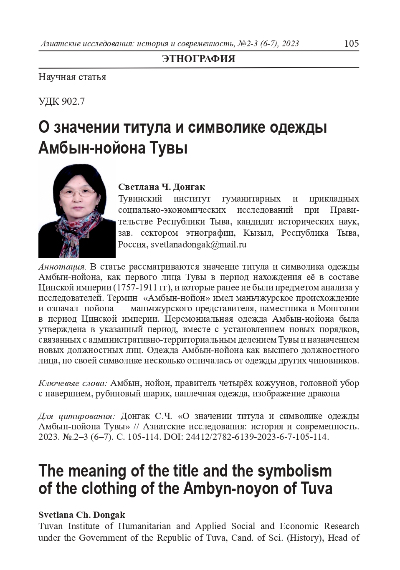
THE MEANING OF THE TITLE AND THE SYMBOLISM OF THE CLOTHING OF THE AMBYN-NOYON OF TUVA
The article discusses the title and clothing of Ambyn-noyon, as the senior official of Tuva during its stay in the Qing Empire (1757-1911). These questions have not been the subject of analysis by researchers. The term Ambyn-noyon is of Manchu origin and generally means "supreme noyon". Ambyn-noyon's clothing was also introduced during this period, along with the establishment of new procedures related to the administrative-territorial division of Tuva and the appointment of new officials. For him, as the highest official, ceremonial clothing was prescribed, which, in its symbolism, was somewhat different from the clothes of other officials.
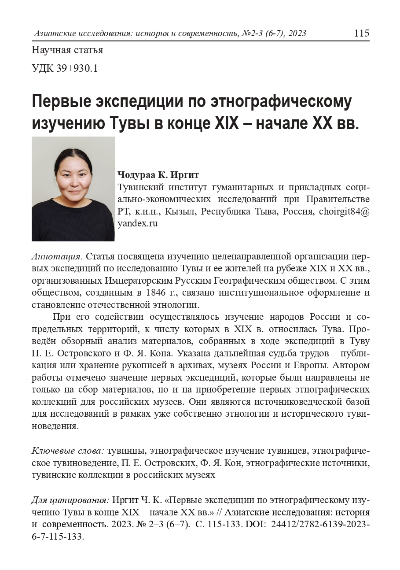
THE FIRST EXPEDITIONS ON THE ETHNOGRAPHICAL RESEARCH OF TUVA IN THE LATE XIX - EARLY XX CENTURIES
The article is devoted to the first expeditions to Tuva and its inhabitants at the turn of the XIX and XX centuries, organized by the Imperial Russian Geographical Society. This society, founded in 1846, is associated with the institutionalization and formation of Russian ethnology. With its assistance, the peoples of Russia and adjacent territories, which included Tuva in the XIX century, were investigated. The author has carried out a review analysis of the materials collected during the expeditions to Tuva by P. E. Ostrovsky and F. Ya. Kon.The further fate of the works was publication or storage of manuscripts in archives, museums in Russia and Europe. The author has noted the importance of the first expeditions, which were aimed not only at collecting materials, but also at acquiring the first ethnographical collections for Russian museums. They are the source base for the research of Tuvan ethnological science.

THE TUVAN MAN IN THE HISTORICAL AND ETHNOGRAPHIC LITERATURE OF THE XIX - BEGINNING. XX CENTURIES (HISTORIOGRAPHICAL REVIEW)
The article is devoted to a brief historiographical review of the works of the 19th - early XX centuries, which examine the economic activities and crafts of Tuvan men in traditional society. These are mainly works of Russian military personnel, geographers, travelers, scientists sent and funded by various research institutions, for example, the Imperial Russian Geographical Society, not only with scientific tasks, but also with the aim of exploring a new potential territory, in the future considered as part of the Russian Empire . In the context of the general characteristics of the people, the male culture of the Tuvans was also touched upon.
Sociology

BUDDISM AND WOMEN IN TUVAN SOCIETY (HISTORICAL AND SOCIOLOGICAL ANALYSIS)
The article investigates the evolution of the and role of women in Buddhism under the influence of changes in cultural tradition in different political, social and spiritual conditions of the historical development of Tuva. The author presents an analysis of the features of women's involvement in socio-religious processes in the Qing period, in the Tuvan People's Republic (TPR), in Soviet and post-Soviet times. The political discourse of anti-religious propaganda among women during the TNR period is described as part of the tactics of the struggle against lamas and religion. It is concluded that only at the present stage women in Tuva have the opportunity to become full participants in the processes in the religious sphere, to comprehend and transmit Buddhist values in the family and society.
THE FINANCIAL SITUATION OF FAMILIES OF THE REPUBLIC OF TUVA (ACCORDING TO THE RESULTS OF A SOCIOLOGICAL SURVEY)
The article presents data from a sociological survey on the study of the financial situation of Tuvan families, conducted by the Center for Sociological Research of the Tuvan Institute of Humanitarian and Socio-Economic Research under the Government of the Republic of Tyva in June 2022. Based on the results of the study, the structure and level of income of respondents was identified. The main sources of income are wages, social benefits, pensions, and help from relatives. There is a high level of debt among the population. The vast majority of survey participants have existing loans.
MIGRATION INTENTIONS OF THE POPULATION OF THE REPUBLIC OF TUVA: DIRECTIONS, REASONS AND MOTIVES
Organa D. Natsak , Chayana B. Darzhaa
The article presents an analysis of migration attitudes of the population of the Republic of Tuva. The authors have used official statistical data and the results of a sociological survey conducted by the Tuvan Institute for Humanitarian and Applied Socio-Economic Research under the Government of the Republic of Tuva (hereinafter - TIGPI) in April 2023 as informational and empirical base of the article. Migration intentions, directions, motives and causes of migration of the population have become the subject of analysis. The survey showed that almost every fifth respondent plans to migrate or thought about migration. Job search, including the search for a well-paid job, affordable medical services and quality education for children are the main reasons for the migration of the population in Tuva.
Socio-economic research
THE EFFECTIVENESS OF THE IMPLEMENTATION OF THE GOVERNOR'S PROJECT "IN EVERY FAMILY - AT LEAST ONE CHILD WITH HIGHER EDUCATION"
This article examines the effectiveness of the Governor's project "In every family – at least one child with higher education", implemented in 2014-2022 in the Republic of Tuva. The main goal of the project was to equalize the opportunities of school graduates living in families in which family members in three generations do not have higher education, through state support in the form of pedagogical and social aid at school and university. Indirectly, the project is aimed at overcoming the poverty of the population in the region. The paper analyzes the dynamics of admission to universities of graduates of schools, colleges, employment of graduates of higher educational institutions, as well as project participants and methods of support from the state. Based on this analysis, a conclusion is formed about the effectiveness of the governor's project.