Issue №4(4), 2022
Issue №4(4)
- Year 2022
- Pages 136
- Published 26 Dec. 2022
- Views 336
- PDF downloads 162
- Permanent link to the issue https://asvestnik.ru/en/issue/4-4-2022
Articles in This Issue
10 itemsHistory

CONTRIBUTION OF HISTORY SECTOR OF TNIIYALI-TIGI-TIGPI TO HISTORICAL TUVINIAN STUDIES
Nikolay M. Mollerov , Ayana A-O. Samdan
The article reveales the continuity of the Scientific Committee of the Tuvan People's Republic (hereinafter – TNR) and the TNIIYALI-TIGI-TIGPI, the role of famous historians of the older generation in solving the tasks facing historical Tuvan studies, the continuation of their traditions in the activities of the history sector in our days. A special attention has been paid to the scientists who wrote the fundamental works for historical Tuvinian studies, as well as to the head of the history sector of TNIIYALI-TIGI-TIGPI.

THE ROLE OF Y. L. ARANCHYN IN DEVELOPMENT OF ECONOMIC RESEARCH IN TUVA AND IN ORGANIZATION OF ACADEMIC SCIENCE UNITS
The article reveals the role of the famous Tuvan scientist, Doctor of Historical Sciences, full member of the Academy of Social Sciences, statesman Y. L. Aranchyn in development of economic research in Tuva, as well as in organization of Tuvan Economic Laboratory of the Institute of Economics and Industrial Production Organization of the Siberian Branch of the USSR Academy of Sciences – the first academic institution in Tuva.
The author points out the importance of the activity of Y. L. Aranchyn as a mentor of young scientists and an educator, who contributed greatly to the dissemination of humanities, including economic knowledge.

WOMEN'S ISSUE IN TUVA AND MONGOLIA IN THE 1920S AND 1930S.
The author analyzes general political origins of approaches to the women's issue, content, forms and methods of working with women in the Tuvan People's Republic (TPR) and the Mongolian People's Republic (MPR) in 1920-1930, taking into account the internal political situation in two countries. The paper concludes that the Communist International played a significant role in including the women’s issue in the political agenda of the People's revolutionary parties in the TPR and MPR, as well as in the formation of an organizational model of work with women. The author reveals Tuvan-Mongolian relations at the level of departments for working with women, created under the Central Committees of the Tuvan National-revolutionary Party and the Mongolian National-revolutionary Party. As a result of the conducted research, it is concluded that political enlightenment, the involvement of Tuvan and Mongolian women in education and culture, sanitary and hygienic knowledge and modern medicine, as well as transformation of everyday life have become the fundamental basis for the further emancipation of women and the achievement of de facto gender equality. From this point of view, the period under review was the most important stage in the formation of a new image of women and new social practices in the nomadic societies of Tuva and Mongolia.
Archaeology

AN ANCIENT TURKIC SCULPTURE FROM THE COLLECTION OF STONE MONUMENTS OF TUVAN INSTITUTE OF HUMANITARIAN AND APPLIED SOCIAL AND ECONOMIC RESEARCH
The author presents a scientific description of the stone statue currently stored in the Tuvan Institute of Humanitarian and Applied Social and Economic Research. There is no information in the scientific archive about the fact when and by whom the statue was brought to the Institute. Techniques used in depicting facial features refer the monument to the ancient Turkic time. The peculiarity of this statue is that the stone on which the man was depicted belongs to an older period than the ancient Turkic time. The statue was carved on a deer stone dating from the Scythian time of the VII-III centuries BC.
ARCHAEOLOGICAL EXPLORATION RESULTS IN ULUGH-KHEM DISTRICT IN 2021
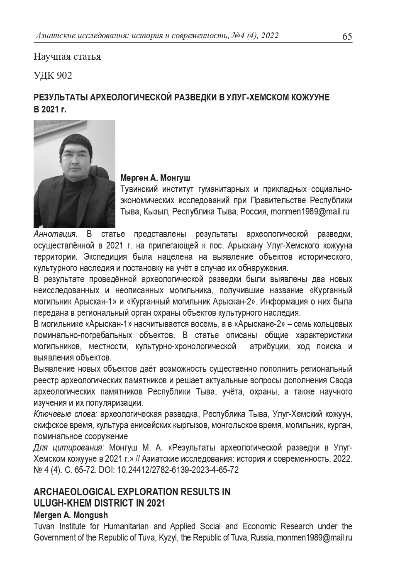
The paper examines some results of the archaeological exploration in the surrounding territory of Aryskan, Ulug-Khem district conducted in 2021. The purpose of this expedition was to discover objects of cultural and historical heritage and register them. The expedition had found early unknown two burial mounds called “Aryskan-1 grave” and “Aryskan-2 grave”. The department of the protection of Cultural Heritage objects on the regional level was informed about findings. There were eight ring memorial and funeral objects in “Aryskan-1 burial ground”, and seven in “Aryskan-2”. The author describes general characteristics of burial grounds and area, cultural and chronological attribution, and the course of the search and identification process. Discoveries make it possible to significantly replenish the regional register of archaeological objects and to solve important issues of supplementing the register of archaeological sites in the territory of the Republic of Tuva, their accounting, protection, and popularization archeological information.

RESULTS OF ARCHAEOLOGICAL EXPLORATION IN THE SURROUNDING AREAS OF KAA-HEM IN 2021
In the result of exploration work on the territory of Kyzyl Kozhuun there were found previously unknown objects of cultural (archaeological) heritage in the surroundings of Kaa-Hem. Discovered two monuments are “Kurgan burial ground “Dar-1” and “Kurgan burial ground “Dar-2”. 28 objects of a funerary and memorial nature were identified totally on the area of two monuments. According to their cultural and chronological features, archaeological objects on the identified monuments can be divided into a wide chronological range from the Bronze Age to the Early Middle Ages - the second millennium BC and the first millennium AC.
Philology

VLADIMIR SEREN-OOL: ANALYSIS OF ONE POEM
The article analizes poetic organization of modern Tuvan poetry. based on the study of one verse Based on the material of one poem, the author reveals such verse-forming elements of expanding rhythm and metrical repertoire of Tuvan verse as 2-syllable and 3-syllable groups (SG), unlike 4-syllable traditional for Tuvan poetry. The author has examined poetry of the Tuvan poet Vladimir Seren-ool (1942-1994) in search of innovations in stanza and new rhythms.

FEATURES OF TRIBAL GROUPS AND THE MODERN LINGUISTIC SITUATION IN KUNGURTUG, THE REPUBLIC OF TUVA
Ellada K-O. Annay , Oyumaa M-O. Saaya , Nachyn M. Mongush , Choygan G. Ondar
The article explores some results of a field sociolinguistic study conducted as part of a comprehensive expedition of the Tuvan Institute of Humanitarian and Applied Socio-Economic Research under the Government of the Republic of Tuva in Kungurtug, Tere-Khol district of the Republic of Tuva (August 2022). The authors have paid the main attention to tribal groups of residents and the current language situation in this local сommunity. The Tere-Khol dialect is one of the peculiar dialects of the Tuvan language. Its phonological system differs from the systems of other dialects by the absence of such an essential feature as the pharyngalization of vowels in the literary Tuvan language. A peculiar linguistic situation in this region is determined by isolated living from the rest of Tuva, presence of tribal groups traditionally living in that territory, and a special way of economic and household life, as well as common usage of the Mongolian language by the majority of the inhabitants of the territory.
Ethnography

FEATURES OF THE ALGYSH PERFORMANCE OF SEANCHUR SOYAN AND TOZHU DEZHIT – SCHAMANS FROM THE TERE-KHOL (BASED ON ARCHIVAL RECORDS FROM THE FUNDS OF TUVAN INSTITUTE OF HUMANITARIAN AND APPLIED SOCIAL AND ECONOMIC RESEARCH)
The article aims to introduce into peculiarities of the algysh chant in the process of kamlaniye of famous shamans - Seanchur Soyan and Tozhu Dezhit from Kungurtug, Terekholsky district of Tuvan ASSR, who were informants of the Soviet ethnographer S. I. Weinstein [Weinstein 1991; Weinstein 2009]. The author has described archival materials contained in the scientific archive of Tuvan Institute for Humanitarian and Applied Social Economic Research under the Government of the Republic of Tuva, which are chanting samples of the above-mentioned shamans. The article is also based on the author's own research conducted during the First All-Russian Festival of shamans "Dungur" in the Republic of Tuva (in Aldyn-Bulak, Kyzyl kozhuun, 20-22, June, 2022). By interviewing the shaman Tos-Kirish Hohoo oglu Ot-ool (born in 1989), a representative of ethnic Tuvinians, living in the sumon Tsengel Bayan-Ulga aimag of Western Mongolia, the author has revealed differences and common features in shamanic ritual of spiritual communication of shamans from Tuva and Mongolia. The author has made a conclusion that the heritage of shamanic folklore with such components as poetic improvisations, intonational manner of chanting, playing the musical instrument demir-khomus during the kamlaniya, used in the shamanic rite complex of these shamans living in the Southwestern part of Tuva, as well as a shaman from Mongolia. The conclusions made are essential for study of mythology and the ancient beliefs of the Tuvans.
Socio-economic research

THE CHANGES IN THE FINANCIAL BEHAVIOR OF THE POPULATION OF THE REPUBLIC OF TUVA
In March 2020 World Health Organization has announced the beginning of the Covid-19 coronavirus pandemic. The infection has also spread in the Republic of Tuva. This article is devoted to the analysis of consumer and financial behavior of the population of the Republic of Tuva in 2020. Quarantine restrictions and state support measures had a significant impact on financial behavior of citizens and the social and economic situation in the region. Nominal and real incomes of the people of Tuva have grown, mainly due to the growth of state social, as well as dependency on state aid. As a result of quarantine restrictions, business income decreased. Despite the increase in income, the population was not inclined to spend finances. The drop in consumer demand was significant in catering, hotel and tourism, cultural and recreational business.