Bayarsaykhan Badarch

Publications by the Author
3 publications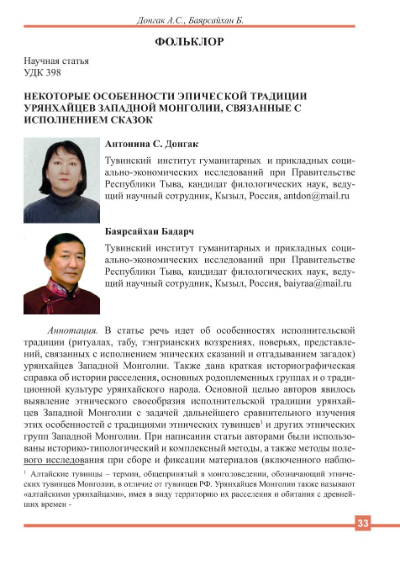
SOME FEATURES OF THE EPIC TRADITION OF THE URIANKHAI PEOPLE OF WESTERN MONGOLIA RELATED TO THE PERFORMANCE OF FAIRY TALES
The article deals with the features of the epic tradition (rituals, taboos, Tengrian views, beliefs, ideas related to the performance of epic tales and riddles) of the Uryankhai people of Western Mongolia. It also provides a brief historiographical background on the history of settlement, the main tribal groups and the traditional culture of the Uryankhai people. The main goal of the authors was to identify the ethnic uniqueness of the performing tradition of the Uryankhai people of Western Mongolia with the task of further comparative study of these features with the traditions of the Tuvans and other Mongolian-speaking peoples. When writing the article, the authors used historical-typological and complex methods, as well as field research methods when collecting and recording materials (involved observation, interviews, surveys), applied the review and generalization method. The novelty of the study is that for the first time in Tuvan folklore studies the authors paid attention to the epic traditions of foreign folklore with the task of further comparative study of two different epic traditions - the Tuvans and the Uriankhais. The material for the study was the field materials of the authors obtained during the implementation of the expeditionary project of the Russian Humanitarian Science Foundation-2015: 15-04-18003 e - “Small ethnic groups of Turkic origin (Khotons, Uriankhais of Mongolia and Tuvans of China): spiritual and material culture” (headed by A.S. Dongak); As a result, the authors came to the conclusion that the epic traditions of the Tuvans and the peoples of Western Mongolia have many common features associated with the performance of fairy tales (seasonal timing, musical accompaniment (although the Tuvans did not always practice accompaniment with instruments), a respectful attitude towards the spirits-masters of the fairy tale and nature, the custom of presenting a small gift to the storyteller, etc.).
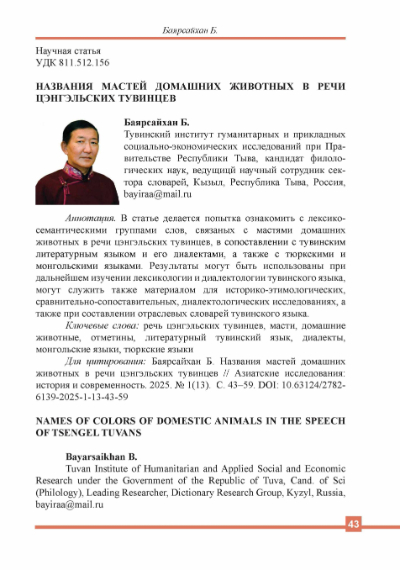
NAMES OF COLORS OF DOMESTIC ANIMALS IN THE SPEECH OF TSENGEL TUVANS
The author attempts to introduce, as far as possible, the peculiarities of the vocabulary associated with the colors of domestic animals in the speech of the Tsengel Tuvans in comparison with the Tuvan literary language and its dialects, as well as with the Turkic and Mongolian languages. The results of the research can be used in further study of the lexicology and dialectology of the Tuvan language and can also serve as material for historical-etymological, comparative-contrastive, dialectological, and industry-specific dictionaries of the Tuvan language.

NAMES OF DOMESTIC ANIMALS’ DESEASES IN THE LANGUAGE OF TSENGEL TUVINIANS IN COMPARISON WITH THE TUVAN LANGUAGE
The Tsengel dialect is one of the foreign dialects of the Tuvan language. It is spoken by the Tuvans of Northwestern Mongolia, who live in the Tsengel sumon of the Bayan-Ulegei aimag. To some extent, we use the concept of “Tsengel dialect” conditionally, because at present the functional status of the Tuvan speech of the indigenous inhabitants of the Tsengel sumon of the Bayan-Ulegei aimag of Mongolia has not yet been established, as a result, the combination “language of the Tsengel Tuvans” sometimes appears in the work, where the term “ language" is not opposed to the term "speech", they are used by us as synonyms. The article provides a comparative analysis of the names of diseases of domestic animals in the speech of the Tsengel Tuvans with the literary Tuvan language, as well as with dialects, in some cases in neighboring Turkic and Mongolian languages.