Issue №1-2(9-10), 2024
Issue №1-2(9-10)
- Year 2024
- Pages 174
- Published 2 Dec. 2024
- Views 344
- PDF downloads 159
- Permanent link to the issue https://asvestnik.ru/en/issue/1-2-9-10-2024
Articles in This Issue
12 itemsHistory
ISSUES OF SETTLEMENT OF THE KIREAN KAZAKHS IN THREE TUVAN KHOSHUNS IN THE ADMINISTRATIVE SYSTEM OF SEVEN KHOSHUNS OF ALTAI URIANKHAI (MID-XIX-EARLY XX CENTURIES)
Gagaa Zolbayar , Nasanbat Erdenebayar
One of the difficult issues in the history of the Kobdos region of Mongolia from the middle of the XIX century to the beginning of the XX century was the history of the settlement of the Kirean Kazakhs, who are part of the nomadic world, on the territory of three Tuvan Khoshuns which were of the administrative unit of seven Khoshuns of the Altai Uriankhai. The authors explore the historical issues of Kazakh migration to these territories and the political conditions in which these processes took place.
Archaeology
BRIEF RESULTS OF ARCHAEOLOGICAL EXPLORATIONS OF 2024 IN THE CENTRAL AND EASTERN REGIONS OF TUVA
The report presents the results of the archaeological survey of the TIGSER Archaeological Survey Center on the territory of three municipal districts of the Republic of Tuva. The exploration team monitored the current state of the ancient settlements of Den-Terek, Mogoy, Kochetovo and the burial ground near the Bosh-Dag mountain in the territories of the Chaa-Khol and Tandy districts. There was found a new fortified settlement of Buren-Khem, located in the Kaa-Khem district. A detailed analysis of the archaeological sites allows us to say that there is a nessesity to take measures for their preservation.
Ethnography
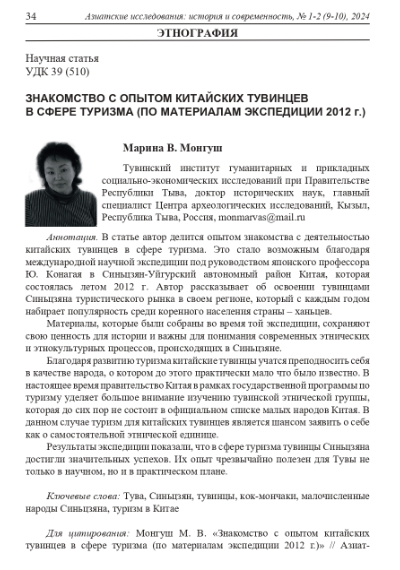
ACQUAINTED WITH THE ACTIVITIES OF CHINESE TUVANS IN THE FIELD OF TOURISM (ACCORDING TO EXPEDITION DATA OF 2012)
The author shares her experience of getting acquainted with the activities of Chinese Tuvans in the field of tourism. This it was possible thanks to an international scientific expedition led by Japanese Professor Yuki Konagaya to the Xinjiang Uygur Autonomous Region of China, which took place in the summer of 2012. The author tells about the development be the Tuvans of Xinjiang tourist market in their region, which is gaining popularity every year among the indigenous population of the country – the Han Chinese. The materials that were collected during that expedition are not only of great scientific interest, but they are also very important for understanding modern ethnic and ethno-cultural processes taking place in Xinjiang. Due to the development of tourism, Chinese Tuvans are learning to present themselves as an exotic people, about whom little was known before. Currently, the Chinese government, within the framework of the state tourism program, pays great attention to the study of the Tuvan ethnic group, which is still not on the official list of small peoples of China. In this case tourism for Chinese Tuvans is a chance to assert themselves as an ethnic unit. The results of the expedition showed that the Tuvans of Xinjiang have achieved significant success in the field of tourism. Their experience is useful for Tuva not only scientifically, but also in practical terms
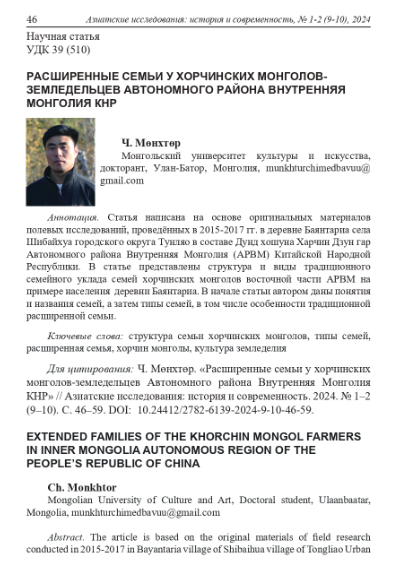
EXTENDED FAMILIES OF THE KHORCHIN MONGOL FARMERS IN INNER MONGOLIA AUTONOMOUS REGION OF THE PEOPLE’S REPUBLIC OF CHINA
The article is based on the original materials of field research conducted in 2015-2017 in Bayantaria village of Shibaihua village of Tongliao Urban District as part of Dongd Khoshun Kharchin Dzung Gar Autonomous Region of Inner Mongolia (ARVM) of the People’s Republic of China. The article presents the structure and types of the traditional family of the Khorchin Mongol of the eastern part of the ARVM on the example of the population of the village of Bayantaria. At the beginning of the article, the author gives the concepts and names of families, and then the types of families, including the features of the traditional extended family.
Philology
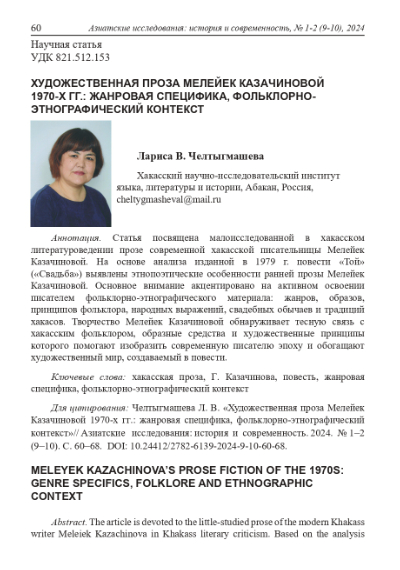
MELEYEK KAZACHINOVA’S PROSE FICTION OF THE 1970S: GENRE SPECIFICS, FOLKLORE AND ETHNOGRAPHIC CONTEXT
The article is devoted to the little-studied prose of the modern Khakass writer Meleiek Kazachinova in Khakass literary criticism. Based on the analysis of novel “Toi” (“The Wedding”) published in 1979, the ethno-poetic features of Meleiek Kazachinova’s early prose were revealed. The main attention is focused on the active development of folklore and ethnographic material by the writer: genres, images, principles of folklore, folk expressions, wedding customs and traditions of the Khakass people. Meleiek Kazachinova’s works reveal a close connection with Khakass folklore, figurative means and artistic principles help to depict the modern era of the writer. Her artistic world view embodies the national mentality, ethno-aesthetic, ideological foundations of the spiritual culture of the Khakass people.
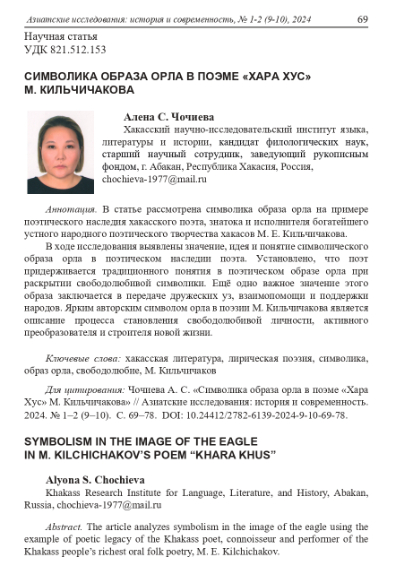
SYMBOLISM IN THE IMAGE OF THE EAGLE IN M. KILCHICHAKOV’S POEM “KHARA KHUS”
The article analyzes symbolism in the image of the eagle using the example of poetic legacy of the Khakass poet, connoisseur and performer of the Khakass people’s richest oral folk poetry, M. E. Kilchichakov. The author revealed the meaning, idea and concept of the symbolic image of the eagle in the poet’s poetic legacy. It is established that the poet adheres to the traditional concept in the poetic image of the eagle when revealing freedom-loving symbolism. Another significant importance of this image is the transfer of friendly ties, mutual assistance and support of peoples. The author’s vivid symbol of the eagle in M. Kilchichakov’s poetry is the description of the process of becoming a freedom-loving personality, an active reformer and builder of a new life.
THE SUBJECT OF MODERN KHAKASS TAKHPAHS
The article analyzes modern takhpakhs performed at the republican competition of takhpakhchi “Aitys”. This song genre is widely popular among listeners, inclining them to reflect on life. Improvisational singers perform takhpahs on topics that excite the people with their acute social orientation. The Khakass takhpahs reflect the way of life, history, traditions, culture and worldview of the people. In recent decades, the theme of this song genre has expanded, tahpahs dedicated to the preservation of the language and national culture have appeared, and the topics of ecology and peaceful life are becoming more relevant.
THE CHUVASH DIASPORA OF SIBERIA: THE PAIN OF BEING DISCONNECTED FROM ITS OWN PEOPLE
The author focuses on folk resettlement songs and oral narratives about the tragedy of the loss of the homeland of Chuvash immigrants from the Volga region to Siberia. Forced resettlement has given rise to a new genre in the folklore tradition – resettlement songs, which are dominated by the theme of separation, the pain of separation from relatives, native places, and ancestral traditions. The resettlement songs were sung by the settlers themselves, they were their kind of “anthem”. This genre has been preserved in a living tradition until the beginning of the XXI century. A new facet of the Chuvash mentality opens up in them: happy is the one who lives in his homeland. The tragedy of the loss of the motherland is acutely manifested in the oral narratives of the Chuvash immigrants and their children. The work is based on the material of the expeditions of the beginning of the XXI century.
Personalities
ARCHIVE FUND OF THE PERSONAL ORIGIN OF THE VETERAN OF TUVAN JOURNALISM AND WRITER K.-K. K. CHOODU
The article analyzes the personal fund of the famous journalist, writer and social activist Kara-Kuske Kunzekovich Choodu. The fund is systematized according to a functional chronological scheme and mainly consists of documents of creative activity (typewritten and handwritten poems) and printed publications (collections of poems and journalistic essays).
KARELINA EKATERINA KONSTANTINOVNA: CULTURAL AND EDUCATIONAL ACTIVITIES, CONTRIBUTION TO THE ART AND SCIENCE OF TUVA (TO THE 60TH BIRTHDAY)
Ulyana O-O. Donorova , Maryatta M-O. Badyrgy , Belekmaa V. Munge
The article presents the scientific and pedagogical path and the results of the activities of Ekaterina Konstantinovna Karelina, Doctor of Art History, educator, Honored Artist of the Republic of Tuva, and member of the Union of Composers of Russia, in the form of a biographical sketch. The biographical data, covering her school and university years, reveal the innate talents and abilities of this gifted individual, nurtured in Soviet society. Her periods of work at the Kyzyl College of Arts named after A. B. Chyrgal-ool, the Tuvan State University, and the Novosibirsk State Conservatory named after M. I. Glinka became important stages in Karelina’s development as an organizer, leader, and mentor to many students, including young scientists, composers, musicians, and educators. These stages also contributed to the formation of her scientific school, dedicated to the study of the history of culture and art in Tuva from the early 1990s to the present day. Special attention is given to Karelina’s contributions to science, education, enlightenment, culture, and the arts in Tuva.
DARYMA O. K.-CH. AS A SCIENTIST, SPIRITUAL PRACTITIONER AND HIS CONTRIBUTION TO THE REVIVAL OF BUDDHISM IN TUVA
This article is a memoir essay dedicated to the scientist, famous folklorist, Honored Worker of the Republic of Tuva O. K-Ch. Daryma (1934-2000). The article is based on the personal memoirs of the author – Ch. O. Adygbai, daughter of Ondar Kish-Chalaevich. There is consideration of the biographical information, previously unknown to a wide range of researchers, related to the scientific activity and relations of the scientist with spiritual teachers, representatives of the Buddhist clergy of Tuva in the last quarter of the XX century. Daryma O.K.-Ch. harmoniously combined in his activities the service of the interests of science and spiritual practices. Biographical information concerns his ancestral origin (tuv. ada-ӧgbe tӧӧgüzü, ugu, tӧrel-aimaa), some of his legendary ancestors, relatives, among whom were, in particular, Dazhyma-hundu Biche-Khovalyg, who was one of the main leaders of the Aldan-Maadyr uprising (1883-1885), and the highly educated Lama Lopsan-Chimit Mongush (1888-1942), the eveloper of one of the variants of the Tuvan script. The spiritual mentors who helped him in mastering the Buddhist tradition were famous lamas: Khomushku Kenden-Syuryun, Kuular Shymbai-ool, Oyun Lundup, who underwent severe trials of repression during the existence of the TNR and the USSR. Despite the persecution and prohibitions, the above-mentioned lamas were known to the people, they were approached to conduct religious sacraments and rituals. The article uses photographs from the family archive for illustrations.
Documents